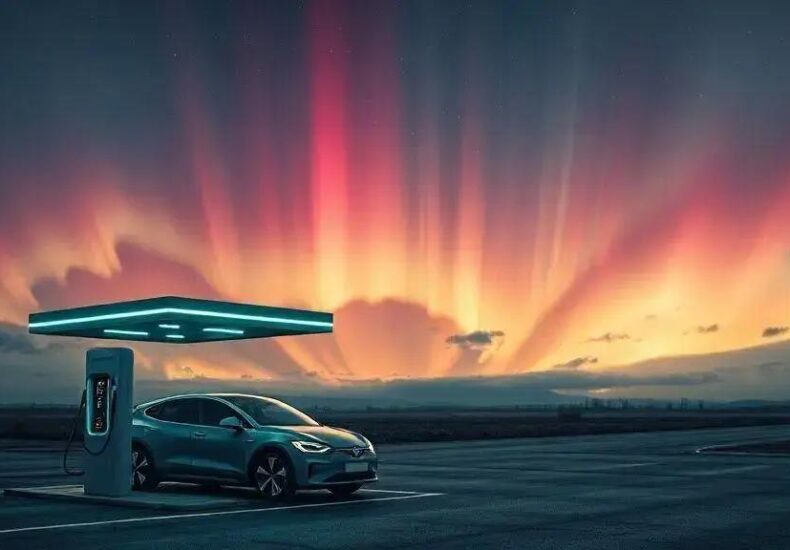
Electric Vehicles vs. Solar Storms: Maintaining a Charged Future
EVs vs Storms refers to the challenges solar storms pose to electric vehicles, impacting charging systems and electronics, with ongoing advancements in protective technologies, policies, and designs aimed at ensuring EV resilience and reliable operation during space weather events.
EVs vs Storms might sound like a sci-fi showdown, but it’s a very real issue as electric vehicles grow in popularity. Have you ever wondered how solar storms could mess with your EV’s charging or even its electronics? Let’s dive into this cosmic challenge and see what keeps our rides ready for the future.
understanding solar storms and their effects
Solar storms are powerful bursts of energy from the sun, consisting mainly of solar flares and coronal mass ejections. These events release massive amounts of charged particles and radiation into space. When this solar activity reaches Earth, it can disrupt electrical systems, satellites, and communication networks.
Solar flares are sudden flashes of brightness on the sun, emitting intense radiation. Coronal mass ejections (CMEs), on the other hand, eject large clouds of solar plasma and magnetic fields toward Earth. Both can cause geomagnetic storms which disturb the Earth’s magnetic field.
These geomagnetic storms can induce electrical currents in power lines, pipelines, and even affect sensitive electronics. In extreme cases, they can lead to power grid failures, satellite damage, and navigation system errors. Such effects raise concerns about the reliability of electric vehicles, which depend heavily on stable electricity and sensitive electronic components.
Understanding how solar storms interact with Earth’s systems is critical to predicting and mitigating their impact. Scientists use satellites and ground-based observatories to monitor solar activity and forecast storms, providing early warnings.
With this knowledge, industries, including the electric vehicle sector, can design protective technologies and protocols to minimize disruptions caused by solar storms. Awareness and preparation play a key role in maintaining the resilience of modern technology in the face of space weather.
how solar storms can impact electric vehicles
Solar storms pose unique challenges to electric vehicles (EVs) because these events can interfere with both the vehicle’s electronic systems and the charging infrastructure. Electric vehicles rely on complex circuits and sensors, which can be vulnerable to electromagnetic disturbances caused by solar storms.
During a solar storm, the surge of charged particles entering Earth’s atmosphere can induce geomagnetic currents. These currents can travel through power grids and charging stations, potentially leading to voltage fluctuations or power outages. Such disturbances may harm EV batteries, charging efficiency, and onboard electronics.
Charging stations connected to the grid are especially at risk because the grid can carry geomagnetically induced currents (GICs). This might cause temporary shutdowns or damage to sensitive equipment, preventing EV owners from charging their vehicles when needed.
Moreover, navigation and communication systems inside EVs may also temporarily malfunction due to disruptions caused by solar radiation. This affects GPS accuracy and connectivity, impacting the driving experience and safety.
Understanding these impacts is vital for manufacturers and users to implement stronger protections and backup systems. By doing so, the resilience of EVs against solar storms can be enhanced, ensuring reliable performance in all conditions.
the science behind EV charging systems
Electric vehicle (EV) charging systems transform electrical energy into a form that can safely and efficiently power a car’s battery. The process involves a charger, power electronics, and the car’s battery management system working together.
Charging types include Level 1, Level 2, and DC fast charging, each offering different speeds and power levels. Level 1 uses a standard household outlet and charges slowly, while Level 2 requires specialized equipment and delivers a faster charge. DC fast chargers bypass the onboard charger and supply power directly to the battery, offering the quickest charging times.
The heart of an EV charging system is the onboard charger, which converts AC power from the grid to DC power that the battery can store. It also controls the charging rate, ensuring the battery is charged efficiently and safely without overheating.
Battery management systems (BMS) play a crucial role in monitoring battery health, temperature, and charge levels during charging. They prevent overcharging and help maximize battery life.
Many EV chargers also include communication protocols to interact with the vehicle and grid, enabling features like smart charging, which can optimize energy use during peak times or when renewable energy is abundant.
Understanding this science helps improve charging technology and supports the growth of EV infrastructure to meet increasing demand.
risk assessment of solar storms to EV infrastructure
Assessing the risks solar storms pose to electric vehicle (EV) infrastructure helps prevent costly damage and service disruptions. Solar storms generate geomagnetically induced currents (GICs) that can overload transformers, power lines, and EV charging stations.
Utility companies conduct risk assessments by analyzing the vulnerability of power grids and identifying critical points that supply EV chargers. These assessments consider factors such as storm intensity, geographic location, and the age of infrastructure.
High-risk areas are those closer to the poles where geomagnetic activity is stronger. In these regions, EV infrastructure may face frequent exposure to solar storm effects, amplifying the need for protective measures.
Evaluations also focus on the resilience of charging stations to sudden voltage spikes, which could damage electronic components within EVs and their chargers. Monitoring equipment helps detect early warning signs of solar activity to activate protective mechanisms.
By understanding the risks, grid operators and EV manufacturers can prioritize upgrades and implement technologies such as surge protectors and grounding systems. These efforts reduce vulnerability and ensure continued access to reliable EV charging.
protective technologies for EVs against solar events
Protecting electric vehicles (EVs) from solar events requires advanced technologies designed to shield delicate electronics and ensure continuous operation. Shielding components and surge protectors are critical in preventing electromagnetic pulses from damaging onboard systems during solar storms.
EV manufacturers incorporate robust insulation and grounding techniques to divert harmful geomagnetically induced currents away from sensitive circuits. Additionally, specialized filters are used to block unwanted electrical noise caused by solar activity.
Battery management systems (BMS) also play a vital role by monitoring voltage and temperature to prevent damage during power fluctuations caused by solar events. These systems can temporarily reduce charging speeds or isolate the battery to avoid overloading.
On the infrastructure side, smart charging stations include surge arresters and fail-safes to protect both the station and the vehicle. Communication protocols enable real-time monitoring of power quality, allowing automatic adjustments when solar storm activity is detected.
Research continues to develop new materials and technologies that enhance EV resilience. From advanced semiconductors to AI-based predictive systems, these innovations aim to keep EVs safe no matter how extreme solar weather becomes.
real-world cases of solar storm disruptions
Several real-world solar storm events have demonstrated how vulnerable modern technology, including electric vehicles (EVs) and power infrastructure, can be to space weather. A famous case is the 1989 Quebec blackout, caused by a severe solar storm that knocked out power for millions of people. This event highlighted how geomagnetic storms can induce currents that damage transformers and disrupt electric grids.
During this blackout, communication systems failed, and emergency services faced significant challenges. Although EVs were not widespread then, the event revealed risks that could affect any electric-dependent technology.
More recently, in 2003, the Halloween solar storm caused satellite malfunctions, GPS errors, and temporary radio blackouts. This storm disrupted navigation systems and showed the potential impact on EVs, especially concerning GPS reliability and communication with charging networks.
In some cases, EV charging stations have experienced outages or irregular performance during solar events, illustrating how critical it is to improve infrastructure resilience. Utilities and vehicle manufacturers use these historical incidents to develop better protection and response strategies.
These real-world cases emphasize the importance of solar storm preparedness. They serve as a reminder that as EV adoption grows, so does the need to safeguard our transportation and energy systems against nature’s powerful space weather.
preparing EVs and grids for solar storm resilience
Preparing electric vehicles (EVs) and power grids for solar storm resilience involves multiple strategies to protect vital systems and ensure uninterrupted service. Grid hardening is a key approach, including installing surge protectors, upgrading transformers, and reinforcing power lines to withstand geomagnetic disturbances.
For EVs, manufacturers focus on designing robust electronics with built-in shields and fail-safes. Battery management systems (BMS) are enhanced to detect anomalies and adjust operation during solar events, preventing damage and ensuring safety.
Smart charging infrastructure also supports resilience by incorporating real-time monitoring and automated responses to changing grid conditions. During solar storms, these systems can reduce charging power or temporarily suspend charging to minimize stress on the network.
Government agencies and utilities collaborate on solar weather forecasting and early warning systems. Access to timely alerts allows operators and EV owners to take precautionary steps, such as unplugging vehicles or switching to backup power sources.
Research into new materials and technologies continues to advance, aiming for even greater protection. This includes AI-based prediction models and innovative circuit designs that better withstand space weather.
policy and industry standards addressing solar storm threats
Policies and industry standards play a crucial role in addressing the threats solar storms pose to electric vehicles (EVs) and the broader power infrastructure. Governments and organizations work together to establish guidelines that improve resilience and safety.
International standards such as those from the International Electrotechnical Commission (IEC) set benchmarks for electromagnetic compatibility and surge protection in EVs and charging systems. These standards ensure products can withstand solar-induced disturbances.
Regulatory bodies also mandate grid reliability standards that require utilities to implement protective measures against geomagnetic storms. These include monitoring geomagnetic activity, hardening critical components, and responding swiftly to alerts.
Industry groups develop best practices for EV manufacturers and infrastructure providers. These best practices focus on robust design, testing under simulated solar storm conditions, and communication protocols for timely information sharing.
Government policies often fund research into space weather prediction and mitigation technologies. They also promote collaboration between space agencies, energy sectors, and automotive industries to enhance overall preparedness.
By aligning policies and standards, the industry can better protect EV technology from solar storms, fostering consumer confidence and supporting the growth of sustainable transportation.
future trends in EV design for solar storm resistance
Future trends in electric vehicle (EV) design will focus heavily on enhancing resistance to solar storms and other space weather effects. As solar activity increases in intensity, engineers are prioritizing durable electronic systems that can endure electromagnetic pulses and voltage spikes.
Innovations include advanced shielding materials that protect critical circuits from radiation and geomagnetically induced currents. Researchers are also exploring the use of hardened semiconductors and redundant electronic architectures to improve system reliability during solar events.
Battery technology is evolving with integrated protection layers and smarter management systems. These innovations help reduce damage from sudden power surges and optimize charging during unstable grid conditions.
AI-driven diagnostics and predictive maintenance will become common, allowing vehicles to detect early signs of solar storm impact and adjust systems proactively. This helps prevent failures and extends device lifespans.
Additionally, vehicle-to-grid (V2G) technology will play a role by allowing EVs to support grid stability and absorb excess geomagnetic-induced currents safely.
Overall, future EV designs aim to blend resilience with smarter connectivity to ensure safety, functionality, and user confidence even during severe solar storms.
what EV owners can do to minimize risks
EV owners can take several practical steps to minimize risks from solar storms and ensure their vehicles remain safe and functional. First, staying informed about space weather forecasts is crucial. Many agencies provide alerts about upcoming solar storms, allowing owners to prepare in advance.
During solar storm warnings, unplugging the EV from charging stations can prevent damage caused by power surges or geomagnetically induced currents. Avoid charging during peak storm activity to reduce stress on the battery and electronics.
Routine maintenance and regular software updates ensure that the vehicle’s protective systems are functioning optimally. Some EVs offer options to adjust charging rates or enter protective modes that can be activated when solar storm risks are high.
Installing surge protectors at home charging stations adds a layer of defense, protecting both the vehicle and electrical systems.
For owners living in high latitude areas with more frequent solar activity, investing in an EV model with enhanced shielding and battery management systems might offer added peace of mind.
By taking these simple yet effective precautions, EV owners can confidently protect their investments against the unpredictable effects of solar storms.
Keeping Electric Vehicles Safe in a Solar Storm World
Solar storms pose real challenges to electric vehicles and the infrastructure they rely on, but understanding these risks is the first step to staying protected.
With advancing technology, smarter policies, and careful preparation by both manufacturers and owners, EVs can be made more resilient against space weather. Simple actions like monitoring solar activity and using protective devices can make a big difference.
As solar storms become more frequent, staying informed and proactive ensures that your EV stays charged and ready no matter what the sun throws our way.
FAQ – Electric Vehicles and Solar Storms
What are solar storms and how do they affect electric vehicles (EVs)?
Solar storms are bursts of energy from the sun that can disrupt electrical systems and electronics, potentially damaging EV batteries and charging stations.
Can solar storms cause EV charging stations to fail?
Yes, solar storms can induce currents that disrupt power grids and charging stations, leading to possible outages or damage to charging equipment.
How can EV owners protect their vehicles from solar storm effects?
EV owners can unplug their vehicles during solar storm warnings, install surge protectors at home charging stations, and keep their vehicle’s software updated for optimal protection.
Are there technologies that help EVs resist solar storm damage?
Yes, modern EVs use shielding, battery management systems, and surge protectors to minimize damage and maintain safe operation during solar events.
How do policies and standards help protect EV infrastructure from solar storms?
Policies and standards set guidelines for designing resilient EVs and charging networks, requiring protective measures and coordination between industries to reduce solar storm risks.
What future trends are expected in EV design regarding solar storm resilience?
Future EV designs will include advanced shielding materials, hardened electronics, AI-driven diagnostics, and vehicle-to-grid technologies to enhance resistance to solar storms.
You may also like




Leave a Reply