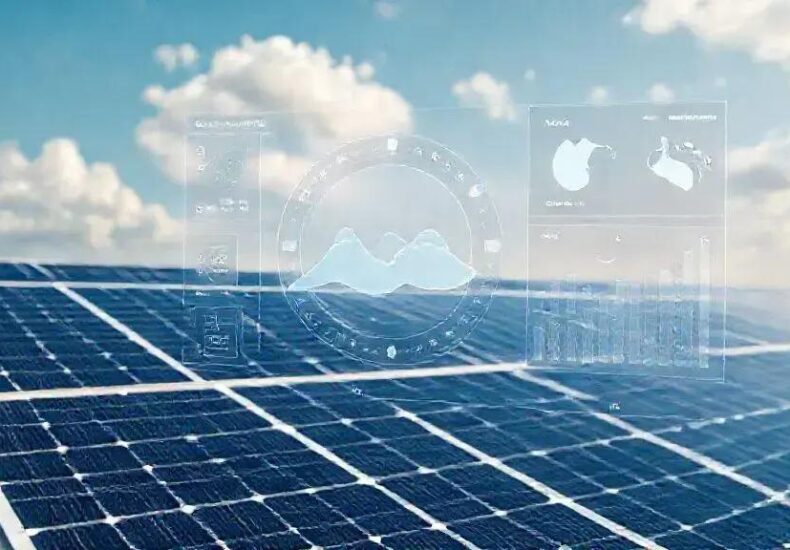
AI in Solar Forecasting: Improving Prediction Accuracy
AI forecasting in solar energy uses machine learning and data analysis to provide accurate solar power predictions, optimizing energy management and enhancing grid reliability.
AI Forecasting is changing the way we predict solar energy output by making forecasts more precise and reliable. Ever wondered how this tech might improve your energy planning and use? Let’s explore the ins and outs together.
what is ai forecasting in solar energy
AI forecasting in solar energy refers to the use of artificial intelligence technologies to predict the amount of solar power that can be generated at a given time and location. By analyzing vast amounts of weather data, solar irradiance, and historical energy production, AI models can provide more accurate and timely predictions than traditional methods.
These systems often use machine learning algorithms that continuously improve as they process more data, learning patterns such as cloud movement, temperature changes, and seasonal variations. This helps utilities and solar plant operators optimize energy distribution, reduce costs, and better integrate solar power into the grid.
AI forecasting is particularly valuable because solar energy availability depends heavily on fluctuating weather conditions. While conventional forecasting might rely on static models, AI-based methods adapt quickly to changing scenarios, ensuring a more reliable energy supply.
For instance, deep learning models can analyze satellite images to detect cloud coverage and predict its impact on solar panel output minutes to hours ahead. This level of precision helps in planning energy storage and meeting demand peaks effectively.
In summary, AI forecasting transforms raw weather and energy data into actionable insights, enabling smarter decisions for all stakeholders involved in solar energy production and management.
how solar forecasting impacts energy management
Solar forecasting plays a crucial role in energy management by predicting the amount of solar power available at any given time. Accurate forecasts help energy providers balance supply and demand more efficiently, reducing waste and avoiding power shortages.
With better predictions, grid operators can plan when to store energy or use alternative sources, ensuring a steady and reliable power supply. This helps lower operational costs and improves the stability of the energy grid.
Solar forecasting also allows businesses and consumers to adjust their energy use based on expected solar availability. For example, industries can schedule high-energy tasks during peak solar production, while homes can optimize battery charging for later use.
Renewable integration becomes easier with precise solar forecasts, as energy managers can more confidently rely on solar power instead of fossil fuels. This promotes cleaner energy usage and supports environmental goals.
In addition, energy markets benefit from accurate solar forecasting by improving pricing models and trading strategies, leading to fairer prices and better investment decisions.
Overall, solar forecasting helps create a more efficient, sustainable, and flexible energy system capable of meeting the needs of a growing renewable energy sector.
key technologies behind ai in solar prediction
Several key technologies drive AI in solar prediction, combining to deliver precise solar energy forecasts. Among these, machine learning stands out as it enables systems to recognize patterns in vast amounts of solar and weather data, improving prediction accuracy over time.
Deep learning, a subset of machine learning, uses neural networks to handle complex data inputs like satellite images and weather maps, making it possible to forecast solar irradiance and cloud cover more effectively.
Another essential technology is computer vision, which processes images from satellites or drones to detect cloud movements and other environmental changes affecting solar power generation.
Additionally, big data analytics plays a vital role by managing and analyzing extensive datasets collected from various sensors, weather stations, and photovoltaic systems. This helps AI models access comprehensive information to generate accurate forecasts.
Integration of Internet of Things (IoT) devices allows real-time data collection from solar panels and weather sensors, feeding live information into AI models for continuous updates.
Finally, cloud computing provides the necessary infrastructure to process large datasets and run complex AI algorithms quickly and efficiently, supporting scalable and accessible solar forecasting solutions.
Together, these technologies create a powerful ecosystem that enhances solar energy prediction, supporting better energy management and sustainability efforts.
data sources for solar forecasting models
Solar forecasting models rely on diverse and extensive data sources to generate accurate predictions. These sources provide crucial information about weather, solar irradiance, and atmospheric conditions that impact solar energy production.
Satellite imagery is one of the primary data inputs. It offers real-time cloud cover, solar radiation, and weather pattern observations over large geographic areas, making it essential for short-term and day-ahead solar forecasts.
Ground-based weather stations contribute localized data such as temperature, humidity, wind speed, and solar radiation. This data refines model accuracy by providing detailed environmental conditions around solar installations.
Solar panel sensors and Internet of Things (IoT) devices collect performance data directly from photovoltaic systems. These inputs help models understand the real output and effectiveness of solar panels under current conditions, informing adjustments to forecasts.
Numerical weather prediction (NWP) models simulate atmospheric behavior using physics-based equations. Their outputs, like predicted cloud cover and solar radiation levels, feed AI models to improve forecast reliability.
Historical weather and energy production data are also vital, as they allow machine learning algorithms to learn patterns and correlations that improve predictive power.
Combining these data sources creates a comprehensive dataset that supports robust solar forecasting models, enabling better decision-making in solar energy management.
challenges in solar forecasting accuracy
Achieving high accuracy in solar forecasting presents several challenges. One major issue is the variability of weather conditions, such as sudden changes in cloud cover, which can be difficult to predict precisely. This often leads to discrepancies between forecasted and actual solar power output.
Another challenge is the limited availability of high-quality data. Incomplete or inaccurate information from weather stations or sensors can weaken the performance of AI models, reducing forecast reliability.
Complex atmospheric phenomena like fog, haze, or dust storms can also affect solar irradiance but are hard to model accurately due to their unpredictable nature and varying intensity.
Solar panel degradation and shading caused by nearby structures or vegetation add local variability that is tough to account for in large-scale models.
Additionally, integrating data from multiple sources can cause inconsistencies or delays, making real-time forecasting more difficult.
Computational limitations pose constraints as well; processing large datasets quickly while maintaining forecast precision requires significant resources and optimization.
Lastly, the dynamic nature of solar energy systems, with frequent changes in configuration or maintenance activities, requires constant updates in the forecasting models to maintain accuracy.
Addressing these challenges is key to improving solar forecasting accuracy and ensuring reliable solar power integration into the energy grid.
machine learning techniques for solar prediction
Machine learning techniques are at the heart of improving solar prediction accuracy. These methods analyze large datasets to identify patterns and trends that traditional models might miss. One popular technique is regression analysis, which predicts solar output by modeling the relationship between input variables like weather conditions and solar irradiance.
Random forests use multiple decision trees to improve prediction accuracy by averaging the outcomes of different models. This technique handles non-linear relationships well, making it useful for complex solar forecasting.
Support vector machines (SVM) classify data points by finding the best boundary between different states, such as cloudy versus sunny conditions, to refine predictions.
Neural networks mimic the human brain’s interconnected neuron structure to detect complex patterns in data. Deep learning, a type of neural network, processes vast amounts of data such as images and time series for improved solar power forecasts.
Reinforcement learning allows models to learn from feedback by taking actions and getting rewards or penalties, which can be applied to optimize solar energy utilization strategies.
Combining multiple techniques in an ensemble approach often yields better results by leveraging the strengths of each method.
These machine learning techniques enable models to adapt to changing conditions and continuously improve with more data, making solar energy forecasts more reliable and useful.
real-world applications of ai in solar forecasting
AI in solar forecasting is already being used in many real-world applications to improve energy management and efficiency. Utility companies use AI models to predict solar power output, allowing them to balance the grid more effectively and reduce reliance on polluting energy sources.
Solar farms utilize AI forecasting to optimize maintenance schedules, monitor panel performance, and predict energy production. This helps increase uptime and maximize power output.
Energy traders depend on AI forecasts to make informed decisions about buying and selling solar energy on markets. Accurate predictions enhance pricing strategies and reduce financial risks.
Smart grids integrate AI solar forecasts to dynamically adjust energy distribution, ensuring reliability even with varying solar generation. This supports a more resilient and sustainable power system.
Commercial and residential consumers can use AI-powered apps to plan their energy use, schedule battery charging, and reduce costs by aligning consumption with solar availability.
Research institutions also apply AI to simulate future solar scenarios under climate change, helping policymakers and planners make better decisions.
Overall, these applications showcase how AI is transforming solar energy by making it more predictable, manageable, and efficient across different sectors.
benefits of improved solar forecasting for consumers
Improved solar forecasting offers several benefits for consumers. More accurate predictions help households and businesses better plan their energy use, reducing costs by optimizing when to draw from the grid and when to use stored solar energy.
Energy savings increase as consumers avoid peak grid rates by aligning their consumption with times of high solar production. This also allows for smarter charging of home batteries and electric vehicles.
Enhanced forecasts contribute to greater energy reliability. Knowing when solar power will be available helps prevent unexpected outages and ensures a steady energy supply.
Consumers can also play a more active role in demand response programs, adjusting their consumption in response to solar availability and grid needs, sometimes earning financial incentives.
Better solar predictions support the wider adoption of renewable energy by making it easier to integrate solar power smoothly with other energy sources, benefiting the environment and society.
Environmental impact improves as consumers rely more on clean solar energy and reduce dependence on fossil fuels, contributing to lower carbon footprints.
Overall, improved solar forecasting empowers consumers to save money, increase energy independence, and support sustainable energy use.
future trends in solar ai forecasting
The future of solar AI forecasting is promising, with several trends shaping how predictions will become even more accurate and useful. One major trend is the integration of advanced neural networks and deep learning, which will process more complex data types, including 3D satellite imagery and environmental sensors, enabling finer granularity in forecasts.
Another trend is the growing use of edge computing. This allows AI models to run on local devices or solar installation sites in real-time, reducing latency and increasing responsiveness for immediate decision-making.
Hybrid models that combine physics-based approaches with AI will enhance the reliability of solar forecasts by blending scientific understanding with data-driven insights.
We also expect better integration with smart grids and IoT, where solar forecasts will dynamically adjust energy flows, storage, and consumption patterns for optimized grid stability.
Cloud computing advancements will support scalable AI solutions, enabling smaller energy providers and communities to access powerful forecasting tools.
The rise of renewable energy markets will increase demand for precise solar prediction to support energy trading and distributed generation.
Lastly, ongoing improvements in data quality and quantity, supported by new satellite missions and sensor deployments, will feed more accurate and timely information into AI models.
These trends will drive solar forecasting toward becoming a cornerstone technology in global efforts to expand clean, reliable energy sources.
how to start using ai for solar energy predictions
Starting to use AI for solar energy predictions involves a few important steps. First, gather quality data such as weather information, solar radiation, and historical energy production. Reliable data is the foundation for effective AI models.
Choose the right AI tools based on your needs and technical skills. Many platforms offer user-friendly interfaces and pre-built models designed for solar forecasting.
Experiment by running small-scale pilot projects to test AI predictions. This helps in understanding how the models work and what improvements are necessary.
Collaborate with experts or vendors specializing in AI and energy forecasting to ensure proper model training and validation. Their expertise can help overcome common challenges.
Integrate AI predictions into your energy management systems. Use the forecasts to plan solar energy use, manage storage, and optimize grid interactions.
Continuously monitor and update the AI models with new data to improve accuracy over time. AI systems learn and adapt, so maintaining them is key to long-term success.
Educate your team about AI tools and their benefits. Training ensures that everyone understands how to leverage solar forecasts effectively.
By following these steps, you can confidently start using AI to enhance solar energy predictions and optimize renewable energy use.
Looking Ahead: Embracing AI for Smarter Solar Energy Forecasting
AI is transforming solar energy forecasting by making predictions more accurate and reliable. This helps utilities, businesses, and consumers make better decisions and save money.
By starting with quality data and the right tools, anyone can begin to tap into the power of AI for solar predictions. Continuous learning and adapting will improve results over time.
As AI technology advances, it will play an even bigger role in integrating clean solar power into our energy systems, supporting a greener and more sustainable future.
Embracing AI in solar forecasting is not just smart—it’s essential for smarter energy management.
FAQ – Frequently Asked Questions about AI in Solar Forecasting
What is AI forecasting in solar energy?
AI forecasting uses artificial intelligence to predict solar power output by analyzing weather data, solar irradiance, and historical energy production.
How does AI improve solar forecasting accuracy?
AI improves accuracy by learning patterns in large datasets, adapting to changing conditions, and processing complex inputs like satellite images and sensor data.
What are the main data sources for solar forecasting models?
Key data sources include satellite imagery, ground-based weather stations, solar panel sensors, numerical weather prediction models, and historical energy data.
What challenges affect solar forecasting accuracy?
Challenges include weather variability, limited data quality, complex atmospheric conditions, local shading effects, and computational limitations.
How can consumers benefit from improved solar forecasting?
Consumers can save money, plan energy use better, increase reliability, participate in demand response programs, and support cleaner energy use.
How can I start using AI for solar energy predictions?
Begin by collecting quality data, selecting appropriate AI tools, running pilot projects, collaborating with experts, integrating AI predictions into your systems, and continuously updating the models.
You may also like



Leave a Reply