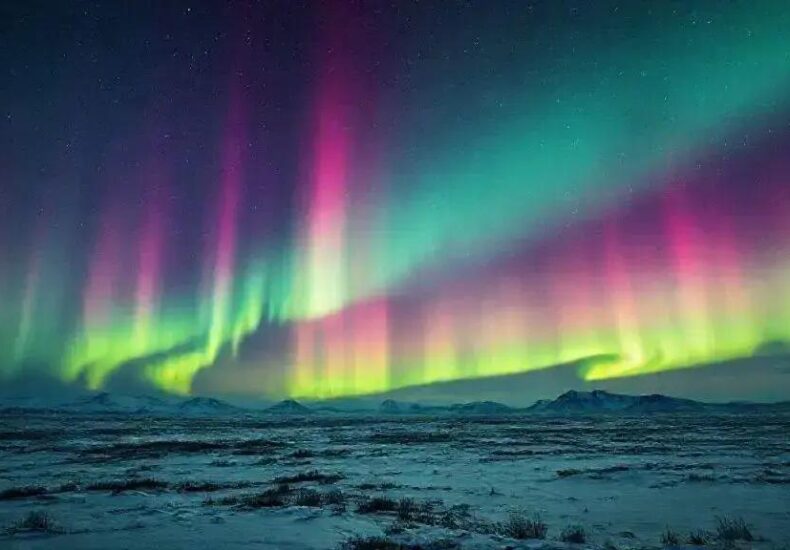
Why Aurora Borealis and Australis Appear During Solar Events
Auroras Explained: Auroras occur when charged solar particles interact with Earth’s magnetic field and atmosphere, producing vibrant light displays near the poles during solar events.
Auroras explained bring to light the dazzling shows we see when particles from the sun meet Earth’s atmosphere. Ever wonder what causes those shimmering colors in polar skies? Let’s dig into the science behind these striking phenomena.
What are auroras and why do they form?
Auroras, also known as the northern and southern lights, are natural light displays predominantly seen near the Earth’s polar regions. They form when charged particles from the sun collide with gases in our planet’s atmosphere, causing the gases to glow in vibrant colors. This breathtaking phenomenon usually appears as shimmering curtains of green, pink, red, or purple light dancing across the night sky.
How Auroras Occur
The sun emits a constant flow of particles called the solar wind. When these charged particles reach Earth, they interact with its magnetic field, funneling them toward the poles. As these particles collide with oxygen and nitrogen atoms in the atmosphere, energy is released in the form of colorful lights.
Colors and Shapes
The tiniest variations in the atmosphere and the type of gas particles involved create the diverse colors of an aurora. Oxygen tends to produce green and red hues, while nitrogen gives off purples and blues. The shapes change dynamically due to shifting magnetic fields and solar wind intensity, making each aurora a unique spectacle.
Why Auroras Are Mostly Seen Near the Poles
Earth’s magnetic field is strongest near the poles, guiding charged solar particles into the upper atmosphere. This is why auroras are usually spotted in high latitude regions such as Alaska, Canada, Scandinavia, and Antarctica. The closer to the poles, the more frequent and intense these glowing shows tend to be.
The role of the sun in creating auroras
The sun plays a crucial role in creating auroras through its continuous emission of charged particles known as the solar wind. These outflows of energy and particles travel through space and interact with Earth’s magnetic field, triggering the beautiful light displays.
Solar Wind and Its Impact
The solar wind consists mainly of electrons and protons released from the sun’s outer atmosphere, or corona. When the solar wind reaches Earth, it disturbs the planet’s magnetic field and funnels charged particles towards the polar regions.
Solar Events That Intensify Auroras
Occasionally, the sun experiences increased activity such as solar flares and coronal mass ejections (CMEs). These events release a larger number of charged particles traveling at high speeds, leading to stronger interactions with Earth’s atmosphere and much brighter auroral displays.
The Sun-Earth Magnetic Connection
The interconnection between the sun’s magnetic field and Earth’s magnetosphere governs the flow of particles. When these magnetic fields align in certain ways, it creates openings that allow solar particles to enter Earth’s atmosphere more easily.
Understanding the sun’s behavior helps scientists predict when auroras will be most visible, improving the chances of witnessing these spectacular natural lights.
Differences between aurora borealis and aurora australis
The aurora borealis and aurora australis are the northern and southern lights, respectively. Both display similar visual effects, but their locations and slight variations set them apart.
Geographical Locations
The aurora borealis appears near the North Pole, visible in countries like Canada, Norway, and Alaska. The aurora australis occurs near the South Pole, seen in places such as Antarctica, New Zealand, and southern parts of Australia.
Appearance and Intensity
Both auroras show vibrant light formations caused by charged particles colliding with Earth’s atmosphere. However, the borealis is often more frequently seen due to easier access to northern landmasses, while the australis is harder to observe because of the remote southern regions.
Scientific Differences
Their formation processes are essentially the same, but the magnetic field’s shape varies slightly between the poles. This affects the exact location and intensity of particle collisions, sometimes causing subtle differences in patterns and colors.
Viewing Experience
People often describe the aurora borealis as having a wider range of colors, including bright greens and pinks. The aurora australis can sometimes appear more muted due to atmospheric conditions but remains equally mesmerizing.
How solar storms intensify aurora displays
Solar storms greatly intensify aurora displays by sending increased numbers of charged particles toward Earth. These storms, caused by bursts of energy from the sun, pack more power than normal solar wind, causing spectacular light shows.
Coronal Mass Ejections (CMEs)
One major type of solar storm is a coronal mass ejection, or CME. This event releases a huge cloud of charged particles traveling at millions of miles per hour. When a CME hits Earth’s magnetic field, it compresses it and forces more particles into the atmosphere.
The Impact on Earth’s Magnetic Field
During solar storms, Earth’s magnetic field shifts and fluctuates rapidly. These disturbances open pathways for energetic particles to enter the upper atmosphere, causing bright, fast-moving auroras that light up the sky with greater intensity and range.
Duration and Magnitude of Auroras
Auroras linked to solar storms tend to last longer and reach farther from the poles, sometimes making them visible at mid-latitudes. The colors appear more vivid and dynamic due to the increased particle activity.
Solar storms remind us how connected our planet is to the sun’s activity, turning calm night skies into enchanting light shows.
The science of Earth’s magnetic field and auroras
Earth’s magnetic field is essential in creating auroras by guiding charged particles from the sun toward the polar regions. This invisible magnetic shield protects our planet from harmful solar radiation and shapes the aurora’s beautiful displays.
How the Magnetic Field Works
Earth generates its magnetic field deep within its core, where liquid iron moves and creates electric currents. These currents create a magnetic field that extends far into space, forming the magnetosphere, which deflects most solar particles.
Magnetosphere and Particle Funnels
The magnetosphere directs charged particles along magnetic lines of force. Near the poles, these lines dip into the atmosphere, acting like funnels that allow solar particles to enter and collide with gases, producing the glowing lights known as auroras.
Magnetic Reconnection and Auroras
Sometimes, the sun’s magnetic field interacts with Earth’s in a process called magnetic reconnection. This event releases energy and opens gaps in the magnetosphere, increasing the flow of charged particles and intensifying aurora activity.
The strength and shape of Earth’s magnetic field affect where and how often auroras occur, making it a key player in the science behind these stunning natural light shows.
When and where to see northern and southern lights
The northern and southern lights are best seen in regions close to the Earth’s magnetic poles. These areas offer darker skies and the right conditions for viewing auroras.
Best Locations for Aurora Borealis
The aurora borealis is most visible in northern countries such as Alaska, Canada, Norway, Sweden, Finland, and Iceland. These places sit within the auroral oval, a ring-shaped zone around the magnetic north pole where auroras are frequent.
Best Locations for Aurora Australis
The aurora australis appears near the magnetic south pole. This makes Antarctica the prime location for viewing, but parts of southern New Zealand, Tasmania, and southern Australia also occasionally enjoy sightings.
When to See Auroras
Auroras occur year-round but are most visible during the darker months of winter and early spring due to extended night hours. The best times are usually between September to March in the north and March to September in the south.
Ideal Viewing Conditions
Clear, dark skies away from city lights provide the best viewing experience. Solar activity also plays a key role; during periods of high solar activity, auroras are more frequent and more vivid, sometimes visible farther from the poles.
Checking local aurora forecasts and planning trips around solar events can increase your chances of catching this stunning natural display.
Impact of solar activity on modern technology
Solar activity can have significant effects on modern technology by disrupting communication, navigation, and power systems. When charged particles from the sun interact with Earth’s magnetic field, they create geomagnetic storms that impact electronic devices.
Effects on Communication Systems
Solar storms can affect radio signals, especially high-frequency (HF) radio used by aircraft and maritime vessels. These disturbances can cause signal loss or delays, impacting safety and operations.
Impact on Satellite Operations
Satellites orbiting Earth face increased risks during periods of high solar activity. Charged particles can damage sensitive electronics, degrade solar panels, and disrupt GPS signals, leading to inaccuracies in location data.
Power Grid Vulnerabilities
Geomagnetic storms induce electric currents in power lines, which can overload transformers and cause power outages. In extreme cases, such as the 1989 Quebec blackout, solar activity led to widespread loss of electricity.
Mitigation and Monitoring
Scientists and engineers monitor solar activity using satellites and ground-based observatories. Early warnings help operators protect vulnerable systems by adjusting satellite orientations, rerouting flights, and safeguarding power grids.
Understanding the impact of solar activity is crucial for maintaining the reliability of our technology-dependent world and preparing for future solar storms.
Future research and exploration of auroras
Future research into auroras focuses on better understanding the sun-Earth connection and predicting auroral activity. Scientists aim to improve satellite technology and ground-based observatories to gather more precise data.
Advancing Space Missions
Space missions like NASA’s Magnetospheric Multiscale Mission (MMS) study the magnetic reconnection process, a key driver of auroras. Future missions plan to explore the sun’s corona and solar wind origins to predict solar storms with higher accuracy.
Improved Auroral Forecasting
With enhanced models and computer simulations, scientists work to provide more reliable aurora forecasts. These advancements can help communities and industries prepare for solar activity impacts.
Exploring the Atmospheric Effects
Research also investigates how auroras influence Earth’s upper atmosphere and climate. Understanding these effects could reveal connections between solar activity and weather patterns.
As technology progresses, the exploration of auroras will deepen our knowledge of space weather and Earth’s environment, unveiling new scientific discoveries.
Understanding Auroras Enhances Our Connection to Space
The study of auroras shows how Earth’s magnetic field and solar activity create stunning light displays near the poles. These events remind us of the powerful influence the sun has on our planet.
With ongoing research and improved technology, we can better predict auroras and protect our modern systems from solar disruptions. Watching the northern and southern lights can inspire awe and curiosity about our place in the universe.
Whether through science or simple wonder, learning about auroras helps us appreciate the dynamic relationship between the Earth and the sun.
FAQ – Frequently Asked Questions about Auroras and Solar Activity
What causes auroras to form?
Auroras form when charged particles from the sun collide with gases in Earth’s atmosphere, causing them to glow with bright colors.
Why are auroras mostly seen near the poles?
Earth’s magnetic field directs charged solar particles toward the polar regions, where they interact with the atmosphere and create auroras.
What is the difference between aurora borealis and aurora australis?
Aurora borealis occurs near the North Pole, while aurora australis appears near the South Pole. Both share similar causes but differ in location and viewing accessibility.
How do solar storms affect auroras?
Solar storms release a high number of charged particles that intensify auroral activity, resulting in brighter and more widespread light displays.
Can solar activity impact modern technology?
Yes, solar activity can disrupt communication, satellite operations, navigation, and power grids due to geomagnetic storms caused by charged particles.
How can I increase my chances of seeing an aurora?
Viewing auroras is best done near the poles during dark, clear nights. Checking solar activity forecasts and avoiding light pollution improve your chances.
You may also like

Leave a Reply