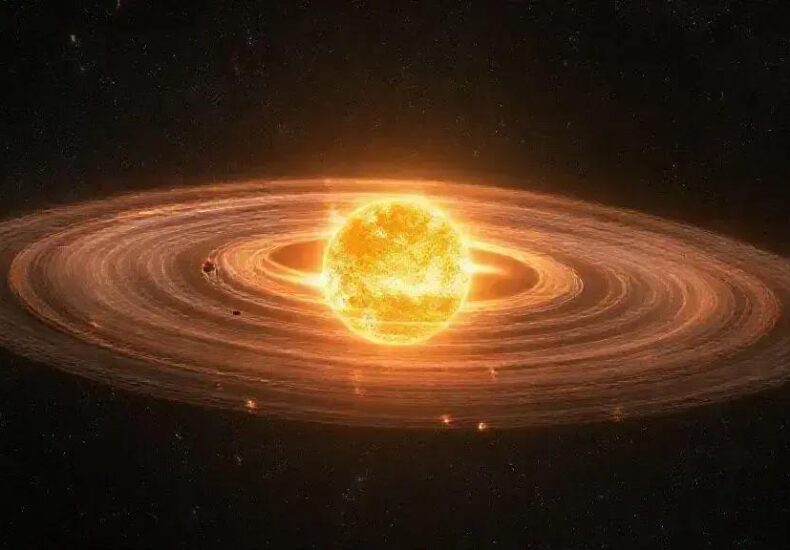
Exploring the Heliosphere: New Studies on Solar System Boundaries
Heliosphere studies examine the solar wind’s protective bubble around the solar system, revealing its structure, interactions with interstellar space, and effects on space weather and cosmic radiation, which are critical for advancing space exploration and safeguarding technology.
Heliosphere studies open a window into the mysterious bubble surrounding our solar system formed by solar winds. Ever wondered how this vast boundary shapes space travel and protects our planets? Let’s dive into what scientists are uncovering about this cosmic frontier.
understanding the heliosphere and its importance
The heliosphere is a vast bubble-like region of space dominated by the solar wind, a stream of charged particles ejected from the Sun. It acts as a shield, protecting the planets from harmful cosmic radiation coming from outside the solar system. This boundary marks the edge where the Sun’s influence wanes and interstellar space begins.
Understanding the heliosphere is crucial because it helps us learn how our solar system interacts with the galaxy around us. It also plays a key role in space weather, which can affect satellites, communications, and even power grids on Earth.
Studying the heliosphere gives scientists insight into how solar winds shape space and affect cosmic particles that enter our solar system. Without this protective bubble, life on Earth could face more intense radiation, making these studies vital for future space exploration and protecting technology.
how solar winds interact with interstellar space
Solar winds are streams of charged particles, mainly protons and electrons, that flow outward from the Sun at high speeds. When these winds reach the edges of our solar system, they encounter the interstellar medium, a sparse mix of gas and dust that exists between stars.
The interaction between solar winds and interstellar space creates a complex boundary called the heliopause, where the pressure from the solar wind balances with the pressure from interstellar particles. This boundary is not fixed; it shifts depending on solar activity and the density of the interstellar medium.
As solar winds collide with interstellar gas, a shockwave known as the termination shock forms, slowing down the solar particles and heating them up. This region, called the heliosheath, acts as a turbulent buffer zone before true interstellar space begins.
These interactions influence cosmic rays—high-energy particles from outside the solar system—either deflecting or allowing them to penetrate deeper into the heliosphere. Understanding this dynamic is essential for predicting space weather and protecting astronauts and spacecraft.
new methods for studying the heliosphere
New methods for studying the heliosphere combine advanced spacecraft technology, remote sensing, and computer modeling. Instruments aboard probes like Voyager and the Interstellar Boundary Explorer (IBEX) collect data on particles and magnetic fields at the edge of our solar system. These missions provide valuable in-situ measurements of the heliosphere’s structure and dynamics.
Innovative imaging techniques allow scientists to map the boundaries of the heliosphere by detecting energetic neutral atoms (ENAs) created when solar wind particles interact with interstellar gas. This method helps visualize areas not reachable by spacecraft.
Cutting-edge simulations using supercomputers model the interaction between solar winds and the interstellar medium, offering predictions and explanations for observed phenomena. Machine learning is also being explored to analyze vast datasets efficiently.
This combination of direct measurement, remote sensing, and computational analysis is transforming our understanding of the heliosphere and its protective role around the solar system.
the role of satellites in heliosphere research
Satellites play an essential role in heliosphere research by providing continuous data on solar wind, magnetic fields, and charged particles far beyond Earth’s atmosphere. Missions such as Voyager, IBEX, and Parker Solar Probe have expanded our knowledge of the heliosphere’s size, structure, and behavior.
These satellites carry instruments capable of measuring energetic particles and imaging energetic neutral atoms (ENAs), which are critical for mapping the heliosphere’s outer boundaries. For example, IBEX creates all-sky maps revealing how the solar wind interacts with the interstellar medium.
The Parker Solar Probe travels closer to the Sun than any previous mission, collecting valuable data on the solar wind’s origins and fluctuations. Meanwhile, Voyager spacecraft have provided in-situ measurements as they reach interstellar space, confirming theoretical models.
By combining data from multiple satellites, researchers gain a comprehensive understanding of how the heliosphere changes over time and reacts to solar activity, improving space weather predictions and our understanding of cosmic radiation protection.
impacts of heliospheric changes on space weather
Changes in the heliosphere have significant impacts on space weather, which refers to the conditions in space that affect Earth and its technological systems. When solar activity increases, such as during solar flares or coronal mass ejections, stronger solar winds push the heliosphere’s boundary outward, altering the flow of charged particles.
These shifts can increase the intensity of space weather events, causing geomagnetic storms that disrupt communications, satellite operations, and power grids on Earth. The heliosphere acts as a protective shield, so variations in its size or strength can affect how much cosmic radiation reaches our planet.
Monitoring heliospheric changes helps scientists predict space weather more accurately, allowing for timely alerts to protect astronauts, spacecraft, and critical infrastructure. Understanding this dynamic environment is vital as we rely more on space-based technology.
Additionally, the heliosphere influences the penetration of galactic cosmic rays into the solar system. When the heliosphere weakens, more cosmic rays can enter, increasing radiation risks for long-duration space missions.
the heliosphere’s influence on cosmic rays
The heliosphere acts as a protective bubble that shields our solar system from most cosmic rays, which are high-energy particles from outside the solar system. These cosmic rays can be harmful to living organisms and spacecraft electronics.
The heliosphere’s magnetic field deflects many cosmic rays, reducing the number that reach Earth and other planets. During periods when the heliosphere is strong, this shielding effect is more effective.
However, when the heliosphere weakens, more cosmic rays can penetrate deeper into the solar system, increasing radiation levels. This can pose risks for astronauts and satellites and affects space weather conditions.
Studying how the heliosphere influences cosmic rays helps scientists understand radiation hazards and develop better protection for space missions. It also offers insights into the complex interactions between our solar system and the wider galaxy.
challenges in modeling the heliosphere
Modeling the heliosphere is a complex task due to the many factors involved, such as solar winds, magnetic fields, and the interstellar medium. These elements interact in unpredictable ways, making it difficult to create accurate models.
One main challenge is understanding the variability of the solar wind, which changes with solar activity and influences the shape and size of the heliosphere. Models must account for these fluctuations over time.
Another difficulty lies in simulating the boundary regions like the heliopause and the termination shock, where solar wind meets interstellar gas. These zones have complex plasma behaviors that are hard to replicate precisely in simulations.
Additionally, the vast scale of the heliosphere requires powerful supercomputers and advanced algorithms to process data and run simulations. Even with modern technology, there are still uncertainties and gaps in knowledge.
Researchers continue developing new methods and refining models to improve our understanding of the heliosphere’s structure and behavior, which is essential for predicting space weather and protecting space missions.
recent discoveries about the heliosheath region
The heliosheath is the outer layer of the heliosphere, where the solar wind slows down and interacts intensely with the interstellar medium. Recent discoveries have revealed that this region is more turbulent and complex than previously thought.
Scientists have observed plasma waves and magnetic field fluctuations within the heliosheath, indicating dynamic processes that affect the shape and size of the heliosphere. These findings come from data collected by the Voyager spacecraft as they traverse this distant region.
New measurements show that the heliosheath’s thickness varies and is influenced by solar cycles and interstellar conditions. This challenges earlier models that considered the heliosheath as a smooth transition zone.
Furthermore, energetic particle populations in the heliosheath provide clues about particle acceleration and cosmic ray modulation, which are crucial for understanding how radiation impacts the solar system environment.
These discoveries highlight the heliosheath’s vital role in defining the boundary between our solar system and the wider galaxy, shedding light on the dynamic edge of solar influence.
how heliosphere studies affect space exploration
Heliosphere studies directly impact space exploration by improving our understanding of the environment that spacecraft must travel through. Knowing the structure and behavior of the heliosphere helps scientists predict space weather conditions and radiation levels outside Earth’s protective magnetosphere.
This knowledge is critical for planning long-duration missions to the Moon, Mars, and beyond. Spacecraft traveling through the heliosphere face risks from charged particles and cosmic rays, which can damage electronics and harm astronauts.
Insights from heliosphere research guide the design of better shielding for spacecraft and help develop safety protocols for crewed missions. Additionally, understanding how solar winds and the heliosphere interact with interstellar space can aid navigation and communication strategies in deep space.
By studying the heliosphere, scientists can also monitor and forecast solar storms that might disrupt missions or satellite operations. This makes heliosphere studies essential for the success and safety of current and future space exploration efforts.
future directions in heliosphere research
Future directions in heliosphere research focus on improving our understanding of this vast space environment using new technology and international collaboration. Advanced spacecraft and sensors will allow scientists to collect more detailed data on solar winds and the heliosphere’s outer boundaries.
One promising area is the development of more sensitive detectors that can measure energetic particles and magnetic fields with greater precision. This will help reveal finer details about how the heliosphere reacts to solar activity and interstellar conditions.
Researchers also plan to use enhanced computer models powered by artificial intelligence and machine learning to simulate heliospheric processes more accurately. These models will support better space weather forecasting and mission planning.
International missions aiming to send probes beyond the heliosphere will provide in-situ observations that are crucial for resolving current unknowns. Collaboration across agencies and disciplines will accelerate progress.
Overall, the future of heliosphere research promises to uncover new insights about our solar system’s boundaries and their importance for protecting life and technology from cosmic threats.
Understanding the heliosphere is key to space science
The heliosphere protects our solar system from harmful cosmic rays and shapes space weather that affects Earth and spacecraft.
New research tools and methods continue to reveal its complex structure and behavior, helping scientists improve space exploration and safety.
As technology advances, we will learn more about this vast cosmic bubble and how it influences our place in the galaxy.
Staying informed about heliosphere studies helps us prepare for the challenges of future space missions and protect technologies we rely on daily.
FAQ – Common Questions About Heliosphere Studies
What is the heliosphere and why is it important?
The heliosphere is a vast bubble created by the solar wind that protects our solar system from harmful cosmic rays and interstellar particles.
How do solar winds affect the heliosphere?
Solar winds are streams of charged particles from the Sun that shape and expand the heliosphere, creating boundaries where they meet interstellar space.
What tools are used to study the heliosphere?
Satellites like Voyager, IBEX, and Parker Solar Probe use instruments to measure particles, magnetic fields, and image energetic neutral atoms to study the heliosphere.
How does the heliosphere impact space weather?
The heliosphere influences space weather by regulating the flow of charged particles and solar storms, which can affect satellites, communications, and power systems on Earth.
Why is modeling the heliosphere challenging?
Modeling the heliosphere is difficult due to its dynamic nature, complex interactions between solar winds and interstellar medium, and the large scale requiring advanced simulations.
How do heliosphere studies help space exploration?
Understanding the heliosphere helps protect astronauts and spacecraft from radiation, improves space weather forecasts, and aids in mission planning for deep space travel.
You may also like

Leave a Reply