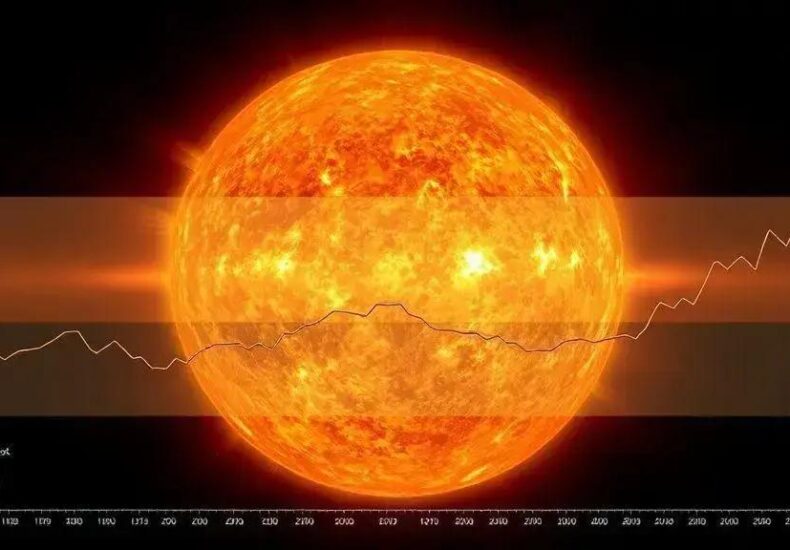
Long-Term Solar Trends: Putting Current Activity into Historical Context
Long-Term Trends in solar activity refer to the sun’s patterns of behavior observed over centuries, including solar cycles, sunspots, and solar storms, which influence Earth’s climate, space weather, and technology through fluctuating solar radiation and magnetic activity.
Long-Term Trends in solar activity offer us a lens to see how the sun’s current mood fits into a much bigger story. Ever wonder what the sun’s behavior today really means when seen alongside centuries of data? Let’s dive in and explore this fascinating history together.
understanding solar cycles and their duration
Solar cycles are natural fluctuations in the sun’s activity that last an average of about 11 years. These cycles are marked by changes in the number of sunspots, solar flares, and other solar phenomena. Understanding solar cycles helps scientists predict space weather and its effects on Earth.
What defines a solar cycle?
Each cycle begins at a solar minimum with fewer sunspots and reaches a solar maximum when sunspot numbers peak. This pattern repeats regularly, but the exact length and intensity of the cycles can vary. The variation in cycle duration typically ranges between 9 and 14 years.
Why duration matters
The length of a solar cycle affects solar radiation and magnetic activity. Longer cycles often lead to different space weather conditions than shorter ones, impacting satellite operations and communication systems on Earth.
Tracking solar cycles
Scientists track cycles using sunspot counts and modern satellite measurements of solar radiation. Historical records from past centuries allow us to compare current cycles with previous patterns, offering insight into long-term solar behavior.
By studying solar cycles and their duration, we gain valuable clues about the sun’s influence on the climate and technology-dependent society.
historical patterns of solar activity over centuries
Studying historical patterns of solar activity reveals how the sun’s behavior has changed over centuries. Scientists use records like sunspot observations, aurora sightings, and ice core samples to trace solar activity back hundreds to thousands of years.
Sunspot records and early observations
Sunspot counts date back to the early 1600s, providing direct evidence of solar cycles. These records show periods of high and low activity, such as the Maunder Minimum, a 70-year span with very few sunspots during the late 1600s.
Proxy data from natural archives
To understand solar activity before telescopes, researchers analyze proxies like carbon-14 and beryllium-10 isotopes found in tree rings and ice cores. These isotopes change with solar radiation levels, offering clues to past solar fluctuations.
Patterns across centuries
Historical data reveals that solar activity varies in both short 11-year cycles and longer periods lasting decades to centuries. These long-term variations influence Earth’s climate and help explain historical climate events.
Scientists continue to integrate different sources of data to build a clearer picture of the sun’s long-term behavior and its impact on the planet.
methods for tracking long-term solar trends
Tracking long-term solar trends requires a combination of historical data and modern technology. Scientists use various methods to monitor changes in solar activity over decades and centuries.
Sunspot observations
One of the oldest methods involves counting sunspots visible on the sun’s surface. Regular records since the early 1600s provide a reliable way to track solar cycles and identify long-term patterns.
Satellite measurements
Modern satellites monitor the sun’s radiation, magnetic fields, and solar wind. These instruments give precise data to observe subtle changes in solar behavior across cycles. Satellites have revolutionized how we understand solar energy output.
Proxy data analysis
Scientists analyze natural records like tree rings and ice cores to study isotopes that vary with solar radiation. This method helps reconstruct solar activity levels before direct observations existed.
Magnetic field monitoring
Earth’s magnetic field responds to solar activity, so measuring geomagnetic variations offers clues about past solar trends. Inventories of these changes can extend back centuries.
Combining these methods, researchers build comprehensive models of the sun’s long-term trends, revealing insights into solar cycles and their influence on Earth.
effects of solar variability on earth’s climate
Solar variability influences Earth’s climate by changing the amount of solar energy that reaches our planet. These changes can affect global temperatures, weather patterns, and atmospheric conditions.
Solar irradiance and climate
The sun’s energy output, called solar irradiance, fluctuates with solar cycles. During periods of high activity, Earth receives slightly more energy, which can lead to warming effects. Conversely, low solar activity may contribute to cooler climates.
Historical climate links
Periods like the Maunder Minimum, with very low solar activity, coincided with cooler temperatures in parts of the world. This shows that solar variability plays a role alongside other factors like volcanic activity and greenhouse gases.
Impact on weather patterns
Changes in solar activity can affect atmospheric circulation and ocean currents, influencing weather trends such as monsoons and droughts. These effects are complex and interact with Earth’s natural climate systems.
Long-term effects
While solar variability drives some climate changes, it is one of several important factors. Understanding its role helps improve climate models and forecasts. Scientists continue researching how solar changes combine with human activities to shape climate.
Overall, solar variability is a key piece in the puzzle of Earth’s dynamic climate system.
comparison of current solar activity with past cycles
Comparing current solar activity with past cycles helps scientists understand where we stand in the sun’s natural rhythm. Measurements today rely on advanced technology, while historical cycles were recorded through simpler methods like sunspot counts.
Current solar activity profile
Recent cycles have shown varied intensity, with some stronger than average and others weaker. The current solar cycle is closely monitored for sunspots, solar flares, and radiation levels to assess its strength.
Historical cycle characteristics
Past cycles have ranged widely, from intense active periods to quiet phases like the Maunder Minimum. These variations influence space weather and Earth’s environment.
Key differences and similarities
While the overall 11-year cycle remains consistent, differences in peak sunspot numbers and cycle duration appear. Modern data shows slightly more detailed behavior, but the pattern fits well within historical ranges.
Scientific significance
Understanding how the current cycle compares to past ones aids in predicting future activity and potential impacts on technologies and climate. Continuous study enhances preparedness for solar-related events.
technological impact of solar storms historically
Solar storms, caused by bursts of charged particles from the sun, have historically impacted technology in significant ways. These storms can disrupt communication, navigation, and power systems on Earth.
Early technological effects
One of the earliest recorded impacts was the 1859 Carrington Event, which caused widespread telegraph failures and even fires in telegraph stations. This event highlighted how solar storms could affect emerging technologies.
Modern technological disruptions
In the 20th and 21st centuries, solar storms have interrupted radio signals, affected GPS accuracy, and damaged power grids. High-frequency radio communications, used by aviation and military, are particularly vulnerable during strong solar activity.
Power grid vulnerabilities
Geomagnetically induced currents from solar storms can overload transformers, leading to blackouts. The 1989 Quebec blackout is a well-known example where a solar storm caused a power outage lasting hours for millions of people.
Satellite and space technology risks
Solar storms increase radiation levels in space, posing risks to satellites and astronauts. Damage to satellite electronics and disruptions in space missions demonstrate the ongoing concerns for space technology.
Understanding the technological impact of solar storms historically helps in developing better protections and forecasting methods to minimize future damage.
using satellite data to monitor solar changes
Satellites play a crucial role in monitoring changes in solar activity by providing continuous and detailed observations of the sun. Instruments onboard measure solar radiation, magnetic fields, and energetic particles, giving scientists real-time data.
Key satellite missions
Programs like NASA’s Solar Dynamics Observatory (SDO) and the Solar and Heliospheric Observatory (SOHO) have revolutionized how we observe solar phenomena. They track sunspots, solar flares, and coronal mass ejections with high precision.
Types of data collected
Satellites collect various data, including ultraviolet and X-ray emissions, solar wind speed, and magnetic field strength. This helps in understanding solar weather patterns and predicting their impact on Earth’s environment.
Benefits for forecasting
Real-time satellite data allows for improved forecasting of solar storms, helping protect power grids, satellites, and communication systems. It also supports astronauts’ safety by predicting radiation hazards.
Using satellite data to monitor solar changes has greatly enhanced our ability to study the sun’s behavior and its effect on Earth’s technology and climate.
predicting future solar activity based on past trends
Predicting future solar activity relies heavily on analyzing patterns from past solar cycles. Scientists use statistical models and historical data to forecast the sun’s behavior in upcoming years.
Analyzing past solar cycles
By studying the length, intensity, and shape of previous cycles, researchers identify trends and irregularities. These patterns help estimate when the next solar maximum or minimum might occur.
Statistical and machine learning models
Modern predictions often use advanced techniques, including machine learning, to analyze large datasets. These models improve accuracy by incorporating multiple variables from historical solar activity.
Solar dynamo theory
The sun’s magnetic field drives solar cycles. Understanding the solar dynamo mechanism allows scientists to simulate how the magnetic field evolves, providing insights into future solar activity.
Challenges in prediction
Despite advances, predicting solar activity remains complex. Variability and unexpected events can disrupt forecasts. Continuous data collection and refinement of models are essential for improvement.
Overall, combining past trends with modern technology enhances our ability to anticipate solar activity, helping prepare for its effects on Earth and space technologies.
solar activity’s influence on space weather and communication
Solar activity greatly influences space weather, which in turn affects communication systems on Earth and in space. Events like solar flares and coronal mass ejections release charged particles that disturb the space environment.
Impact on satellite communication
Solar storms can disrupt radio signals and satellite operations. Increased radiation can damage satellite electronics and reduce signal reliability, affecting GPS and communication networks.
Effects on radio transmissions
High-frequency radio waves used for aviation and maritime communication are sensitive to solar activity. Solar flares can cause sudden radio blackouts, disrupting critical communications.
Influence on space weather
Solar energetic particles interact with Earth’s magnetosphere, causing geomagnetic storms. These storms create auroras but can also induce currents harmful to power grids and communication lines.
Mitigation and forecasting
Monitoring solar activity with satellites helps predict space weather events. Early warnings allow operators to protect satellites and adjust communication systems to minimize disruptions.
Understanding solar activity’s role in space weather is essential for maintaining reliable communication in our technology-dependent world.
challenges in interpreting long-term solar records
Interpreting long-term solar records presents several challenges due to the complexity and limitations of available data. These obstacles make it difficult to form a complete and accurate picture of the sun’s historical behavior.
Data gaps and inconsistencies
Historical records such as sunspot counts are often incomplete or inconsistent, especially before modern observations began. This can lead to uncertainties in understanding solar cycles from centuries ago.
Proxy data limitations
Scientists rely on proxies like carbon-14 and beryllium-10 isotopes to infer solar activity before telescopes existed. However, these proxies can be influenced by other environmental factors, complicating the interpretation.
Changing measurement techniques
Different methods and instruments over time cause variations in data quality. Calibrating older measurements with modern standards is challenging but necessary for reliable analysis.
Natural variability and noise
The sun’s natural variability, combined with Earth’s climatic and geological processes, creates noise in the data. Separating true solar signals from this noise requires advanced statistical methods.
Understanding these challenges is vital for improving long-term solar activity reconstructions and enhancing our knowledge of the sun’s impact on Earth.
Understanding long-term solar activity is key
Studying the sun’s long-term behavior helps us better predict future solar activity and its effects on our planet. While challenges exist in interpreting historical data, ongoing research and technology improve our understanding.
By combining old records with modern tools, scientists are uncovering valuable insights about the sun’s influence on climate, technology, and space weather. This knowledge supports better preparation for solar impacts on Earth.
Staying informed about solar trends is important as we depend more on technology sensitive to space weather. Continued efforts to refine data and models will help us better face the sun’s changing rhythms in the years ahead.
FAQ – Frequently Asked Questions about Long-Term Solar Trends
What are solar cycles and why do they matter?
Solar cycles are about 11-year periods of changing solar activity marked by sunspots and solar flares. They help us understand the sun’s behavior and its effects on Earth.
How do scientists study solar activity from centuries ago?
Researchers use sunspot records, historical observations, and natural proxies like isotopes in tree rings and ice cores to reconstruct past solar activity.
Why is it challenging to interpret long-term solar records?
Data gaps, changing measurement methods, and natural environmental influences create uncertainties in the solar records, making interpretation complex.
How does solar activity affect Earth’s climate?
Variations in solar energy output influence global temperatures and weather patterns. Periods of low activity are linked to cooler climates, while high activity may cause warming effects.
What impact do solar storms have on technology?
Solar storms can disrupt satellite communications, damage power grids, and cause radio blackouts, affecting technologies that rely on space weather conditions.
How do satellites help monitor solar activity?
Satellites provide real-time data on solar radiation, magnetic fields, and solar flares, helping predict space weather and protect Earth’s technology and astronauts.
You may also like



Leave a Reply