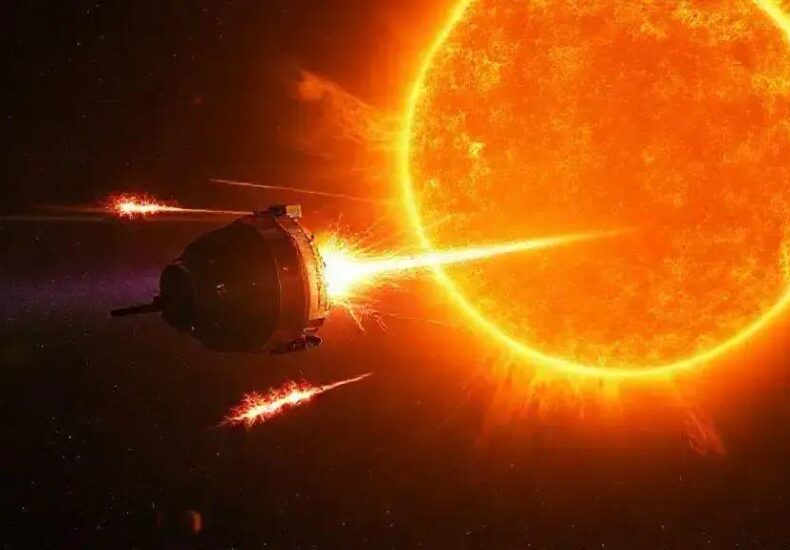
Parker Solar Probe’s Recent Discoveries: A Breakthrough in Understanding
The Parker Solar Probe is a NASA mission designed to study the sun’s corona up close, revealing new insights into solar wind, magnetic fields, and space weather that improve prediction models and protect Earth’s technology.
Parker Probe has been rewriting the story of our sun with discoveries that might just change how we see the space around us. Ever wondered what secrets the sun’s atmosphere hides? Let’s dive into the latest insights this mission is bringing back to Earth.
Overview of the Parker Solar Probe mission
The Parker Solar Probe mission, launched by NASA in 2018, aims to study the sun closer than any spacecraft before. Its journey takes it through the sun’s outer atmosphere, known as the corona, to gather crucial data about solar activity and the solar wind. The probe’s unique design allows it to withstand extreme heat and radiation while traveling at record speeds. Through multiple close passes, it collects information on magnetic fields, plasma waves, and energetic particles, helping scientists understand how the sun affects the entire solar system. This mission marks a major step forward in solar physics and space weather prediction.
Mission Objectives
The primary goals include tracing the flow of energy and understanding the heating of the solar corona, determining the structure and dynamics of solar wind plasma, and exploring the mechanisms accelerating solar energetic particles. These objectives guide every aspect of the probe’s design and operations.
Technological Innovations
The Parker Solar Probe features the Thermal Protection System (TPS), an advanced shield that keeps the instruments safe from temperatures exceeding 2,500 degrees Fahrenheit. This technology, combined with solar-powered instruments and autonomous navigation, allows it to operate so close to the sun.
By pushing the boundaries of aerospace engineering, the Parker Solar Probe provides unprecedented access to the sun’s environment, paving the way for new discoveries and a deeper understanding of our star.
Key discoveries made by the Parker Probe
The Parker Solar Probe has made several groundbreaking discoveries since its launch. One major find is the detailed observation of solar wind acceleration, revealing that particles near the sun move faster and with more turbulence than previously thought. These insights challenge existing theories and provide clues about the sun’s magnetic fields.
Magnetic Switchbacks
The probe detected sudden changes, called magnetic switchbacks, where the sun’s magnetic field lines sharply bend and snap back. These phenomena may play a key role in heating the solar corona and accelerating solar wind particles.
Coronal Heating Puzzle
Another important discovery is related to the coronal heating problem. The probe’s data suggest that waves and energetic particles transfer heat to the sun’s outer atmosphere, helping explain why the corona is much hotter than the surface below.
Solar Wind Source Regions
The Parker Probe has also identified the source regions of different types of solar wind, improving our understanding of how fast and slow solar wind streams originate and how they impact space weather.
Overall, these findings help scientists better predict solar storms and their effects on Earth’s technology and environment.
How the probe studies the sun’s corona
The Parker Solar Probe studies the sun’s corona by traveling closer to the sun than any previous spacecraft, allowing it to collect data directly from this hot outer atmosphere. The probe is equipped with four instrument suites that measure electric and magnetic fields, plasma waves, energetic particles, and images of the sun’s corona. These instruments work together to capture detailed information about the sun’s dynamic environment.
Measuring Plasma and Magnetic Fields
The probe’s sensors detect charged particles or plasma, which make up the corona and solar wind. By measuring magnetic fields, scientists can understand how magnetic energy is released and how it drives solar activity such as flares and eruptions.
Imaging the Corona
One of the instruments captures high-resolution images of the corona, revealing structures like solar loops and streamers. These images help scientists see how the corona changes over time and how energy flows from the sun’s surface to the outer atmosphere.
Studying Solar Wind and Particles
The Parker Solar Probe tracks the solar wind’s speed, direction, and composition. It also measures energetic particles accelerated by solar storms, providing insight into space weather that can affect Earth.
These direct measurements give scientists a better understanding of the processes heating the corona and accelerating particles, filling gaps left by remote observations.
Implications for solar wind understanding
The Parker Solar Probe has greatly enhanced our knowledge of the solar wind, the stream of charged particles flowing outward from the sun. It has shown that the solar wind is more complex and variable than previously believed. These new insights help explain how the solar wind affects space weather and interacts with Earth’s magnetic field.
Understanding Solar Wind Acceleration
The probe’s data suggest that magnetic waves and switchbacks in the corona play a crucial role in accelerating solar wind particles to high speeds. This challenges older models that could not fully explain the source of the solar wind’s energy.
Impact on Space Weather Forecasting
Improved knowledge of solar wind behavior allows scientists to better predict space weather events, such as solar storms that can disrupt satellites, communications, and power grids on Earth. The Parker Probe’s findings contribute to building more accurate models.
Variability of Solar Wind Streams
The probe has identified distinct types of solar wind streams, including fast and slow winds, with different origins and properties. This helps explain variations in the space environment around Earth and throughout the solar system.
These discoveries deepen our understanding of the sun’s influence on planetary environments and pave the way for future space exploration and technology protection.
Technological challenges overcome by the mission
The Parker Solar Probe mission has overcome significant technological challenges to achieve its goal of studying the sun up close. One of the greatest hurdles was designing a spacecraft capable of withstanding extreme temperatures exceeding 2,500 degrees Fahrenheit while remaining fully operational.
Thermal Protection System
The probe’s key innovation is its Thermal Protection System (TPS), a heat shield made of carbon-composite materials that reflect and absorb intense heat. This shield keeps the instruments at room temperature despite the scorching environment.
Autonomous Operations
Because the probe operates so close to the sun, it faces communication delays with Earth. It is equipped with advanced autonomous systems that allow it to adjust its position and protect itself in real time.
High-Speed Travel and Navigation
The probe travels at record-breaking speeds, over 430,000 miles per hour, requiring precise navigation to ensure it follows the correct orbit and avoids damage. Its solar panels are specially designed to change angle and minimize sun exposure while providing power.
These technological feats make the Parker Solar Probe one of the most advanced spacecraft ever built, enabling it to explore the sun’s secrets safely and effectively.
Impact on predicting space weather events
The Parker Solar Probe has improved our ability to predict space weather events by providing detailed data on solar activity. Solar storms, caused by eruptions such as solar flares and coronal mass ejections, can disrupt satellite communications, GPS signals, and even power grids on Earth.
Early Detection of Solar Storms
By flying close to the sun, the probe captures early signs of solar storms, like changes in magnetic fields and particle flows. This allows scientists to predict when and how these storms might impact Earth.
Real-Time Monitoring of Solar Particle Events
The probe measures energetic particles emitted during solar storms, giving insight into their speed and intensity. This information is crucial for issuing timely warnings and protecting astronauts and sensitive technology.
Enhancing Predictive Models
Data from the Parker Probe helps improve computer models that forecast space weather by refining our understanding of solar wind behavior and storm development. These enhanced models lead to more accurate and reliable predictions.
These advancements are vital for protecting modern technology and maintaining communication systems that rely on space-based infrastructure.
Comparisons with previous solar observation missions
The Parker Solar Probe represents a major leap beyond previous solar observation missions. Unlike earlier spacecraft that observed the sun from a distance, Parker travels directly into the sun’s corona, collecting firsthand data in an extreme environment.
Advancements Over Past Missions
Previous missions such as Helios and the Solar and Heliospheric Observatory (SOHO) provided valuable insights but were limited by their orbits and distance from the sun. The Parker Probe’s trajectory brings it much closer to the solar surface, enabling more detailed and direct measurements.
Technology and Instrumentation
The probe employs state-of-the-art instruments and a heat shield to survive intense heat and radiation. This contrasts with earlier missions that could only operate in cooler, less intense regions of space.
Scientific Contributions
While earlier missions laid the groundwork for understanding solar wind and magnetic fields, Parker’s data reveal phenomena like magnetic switchbacks and coronal heating mechanisms at unprecedented resolution.
This mission opens new horizons for solar science, enhancing what we’ve learned from past efforts and pushing the boundaries of space exploration.
What future research the Parker Probe enables
The Parker Solar Probe has opened new doors for future solar research by providing critical data about the sun’s atmosphere and solar wind. Scientists can now explore questions about how energy moves through the corona and how solar storms begin with a level of detail never possible before.
Understanding Solar Dynamics
Future research will focus on the physical processes heating the sun’s outer layers and accelerating particles. The probe’s findings guide the development of new theories and models to explain these complex dynamics.
Space Weather Forecasting
With better knowledge from Parker, researchers will improve forecasts of solar storms that affect Earth and space technology. This will help protect satellites, astronauts, and power grids.
Complementary Missions and Technologies
The mission paves the way for future spacecraft and instruments to explore different parts of the sun and its environment. Scientists plan to combine Parker’s data with observations from other missions, creating a fuller picture of solar activity.
The Parker Solar Probe’s groundbreaking discoveries will fuel a new era of solar science, ensuring we better understand our sun and its impact on the solar system.
How Parker Probe findings affect daily technology
The Parker Solar Probe has provided valuable insights that impact daily technology by improving our understanding of space weather. Solar storms generated by the sun can disrupt satellite communications, GPS navigation, and even power grids on Earth.
Protecting Satellite Communications
By studying solar wind and magnetic fluctuations, the Parker Probe helps predict conditions that may interfere with satellites. This information aids in safeguarding communication networks vital for phones, internet, and broadcasting.
Enhancing GPS Accuracy
Solar activity can cause errors in GPS signals. Data from the probe allow engineers to develop better correction methods, ensuring more reliable navigation for everything from smartphones to aircraft.
Securing Power Grids
Solar storms can induce currents that damage electrical infrastructure. Understanding the sun’s behavior through Parker’s findings helps power companies prepare and minimize outages, preserving essential services.
Overall, the mission’s discoveries support the resilience and efficiency of technologies that billions depend on daily, linking space science directly to everyday life.
Understanding the Impact of the Parker Solar Probe
The Parker Solar Probe has transformed how we understand the sun and its effects on our technology. Its discoveries give us tools to better predict space weather, helping protect satellites, navigation systems, and power grids.
By studying the sun up close, this mission bridges the gap between space science and everyday life. As technology becomes more connected to space, the insights from Parker play a key role in keeping our modern world running smoothly.
Continued research based on these findings will further enhance our ability to prepare for and respond to solar events, making the probe’s mission a vital part of our future.
FAQ – Common Questions About Parker Solar Probe and Its Discoveries
What is the primary goal of the Parker Solar Probe mission?
The primary goal is to study the sun’s outer atmosphere, the corona, to better understand solar activity, solar wind, and space weather.
How does the Parker Solar Probe survive extreme heat near the sun?
It uses a special Thermal Protection System, a heat shield made from carbon-composite materials that reflect and absorb intense heat to protect its instruments.
What are magnetic switchbacks discovered by the Parker Probe?
Magnetic switchbacks are sudden bends and snaps in the sun’s magnetic field lines that may help heat the corona and accelerate solar wind particles.
How do Parker Probe findings help with space weather forecasting?
The probe provides early data on solar storms and solar wind behavior, improving models that predict space weather events which can affect Earth’s technology.
What technological challenges did the Parker Solar Probe overcome?
The mission overcame challenges like extreme heat, high-speed travel, and communication delays by developing advanced heat shields, autonomous systems, and precise navigation.
Why are the Parker Solar Probe’s discoveries important for everyday technology?
Its findings help protect satellites, improve GPS accuracy, and secure power grids by enhancing our understanding and prediction of harmful solar storms impacting Earth.
You may also like


Leave a Reply