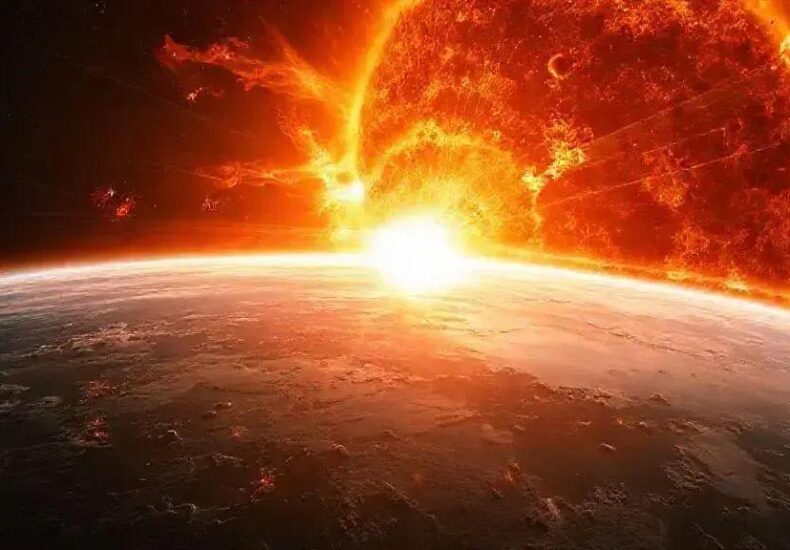
Myth or Reality: Can We Predict Solar Storms Years in Advance?
Predicting storms years in advance remains unreliable due to the sun’s complex behavior, but advances in satellite technology, AI, and global data sharing are improving solar storm forecasting capabilities.
Predicting storms years in advance feels like science fiction, right? But with growing space weather risks, it’s worth asking: can we really forecast solar storms far ahead? Let’s unpack what science says and where uncertainties linger.
understanding solar storms and their origins
Solar storms, also known as space weather events, originate from the sun’s dynamic and powerful activities. They often begin with solar flares or coronal mass ejections (CMEs), which are bursts of charged particles and magnetic fields launched into space. These storms can impact Earth when they interact with our planet’s magnetic field.
Solar flares and coronal mass ejections
Solar flares are sudden flashes of increased brightness on the sun’s surface caused by magnetic energy release. CMEs are massive clouds of solar plasma ejected at high speeds. Both can trigger intense geomagnetic storms when directed toward Earth.
The solar cycle’s role
The sun follows an approximately 11-year cycle, fluctuating between solar minimum and maximum phases. During solar maximum, storm activity increases due to heightened sunspot and flare occurrences, influencing the frequency and intensity of solar storms.
Magnetic field interactions
Solar storms affect Earth through interactions with its magnetic field, sometimes causing auroras near polar regions. However, strong storms can disrupt satellite communication, power grids, and navigation systems, making understanding their origins crucial.
Grasping how solar storms start and develop is key to advancing prediction methods and preparing for potential impacts on technology and daily life.
current methods for detecting solar storms
Detecting solar storms relies on a mix of advanced technologies and scientific methods that monitor the sun’s activity in real time. Instruments on satellites and ground stations track solar flares, sunspots, and coronal mass ejections (CMEs) to identify storm precursors.
Satellite monitoring systems
Space-based observatories such as NASA’s Solar Dynamics Observatory (SDO) and the Solar and Heliospheric Observatory (SOHO) continuously record solar radiation and imagery. These satellites provide vital data about the sun’s atmosphere and magnetic fields.
Solar wind measurements
Probes like the Advanced Composition Explorer (ACE) measure the speed, density, and magnetic properties of solar wind particles. Changes in these parameters help predict when solar storms might reach Earth.
Ground-based observatories and magnetometers
Earth-based telescopes track sunspots and solar flares, while magnetometers measure disturbances in Earth’s magnetic field caused by incoming solar activity.
These combined methods create a comprehensive monitoring system, allowing scientists to issue warnings and prepare for possible impacts on satellites, power grids, and communication systems.
the science behind long-term storm prediction
Long-term prediction of solar storms is a complex challenge that relies on understanding the sun’s magnetic cycles and patterns. Scientists use data from past solar cycles to forecast future activity, but accuracy drops significantly over extended periods.
solar cycle analysis
The approximately 11-year solar cycle helps scientists anticipate periods of increased or decreased solar activity. This cycle is driven by changes in the sun’s magnetic field, which produce sunspots and solar eruptions.
magnetic field modeling
Advanced computer models simulate the sun’s magnetic field and how it evolves over time. These simulations aim to predict the timing and strength of solar storms by tracking magnetic energy buildup.
limitations and uncertainties
Despite progress, long-term storm prediction faces obstacles such as incomplete data and the inherent chaos of solar dynamics. Variations in the sun’s behavior can disrupt even well-established models, making precise forecasts years ahead difficult.
Current science focuses on improving models and incorporating more data to enhance reliability, but predicting solar storms years in advance remains an area of ongoing research.
limitations of predicting solar storms years in advance
Predicting solar storms years in advance is extremely difficult due to several inherent challenges. The sun’s behavior is highly complex and influenced by many factors that scientists cannot yet fully model or anticipate.
chaos and unpredictability in solar activity
The sun’s magnetic field changes in unpredictable ways, creating a chaotic environment. Small differences in initial conditions can lead to large variations in outcomes, which limits the accuracy of long-term forecasts.
limited historical data
Reliable solar data only dates back a few decades with modern instruments. This short record makes it hard to identify consistent patterns needed for accurate long-range predictions.
technological and model constraints
Current computational models cannot fully simulate all aspects of the sun’s magnetic field and plasma dynamics. This leads to uncertainties in storm timing and intensity predictions.
Despite these limitations, ongoing research aims to improve models and extend forecasting windows, but precise predictions years ahead still remain elusive.
technologies aiding space weather forecasting
Space weather forecasting depends on several advanced technologies that help monitor and predict solar storms. These tools collect data from space and Earth to track solar activity and its effects.
satellite instruments
Satellites like NASA’s Solar Dynamics Observatory (SDO) and the Deep Space Climate Observatory (DSCOVR) provide real-time imagery and data about solar flares and solar wind. They help scientists observe solar events as they occur.
ground-based sensor networks
Ground stations use magnetometers and radio telescopes to detect changes in Earth’s magnetic field and radio emissions. These sensors help confirm solar storm impacts and assess their strength.
computational models
Advanced computer simulations process vast amounts of data to predict the path and intensity of solar storms. These models take into account solar wind speed, magnetic fields, and historical patterns to forecast space weather conditions.
Together, these technologies improve early warnings, helping protect satellites, power systems, and communication networks from solar storm damage.
impact of solar storms on earth and technology
Solar storms can have major effects on Earth and modern technology. When charged particles from solar flares or coronal mass ejections hit Earth’s magnetic field, they cause geomagnetic storms that disrupt many systems.
effects on power grids
Geomagnetic storms can induce electric currents in power lines, causing outages and damage. Large storms have led to blackouts, sometimes impacting millions of people.
satellite and communication disruption
Solar storms interfere with satellites, harming GPS signals, radio communication, and even spacecraft electronics. These disruptions affect navigation, military operations, and everyday communication.
radiation risks
Increased radiation from solar storms poses threats to astronauts and high-altitude flights. Airlines may reroute flights to reduce exposure during intense solar activity.
Understanding these impacts helps improve preparedness and safeguard critical infrastructure against solar storm damage.
real examples of forecast successes and failures
Forecasting solar storms has seen both successes and failures over the years, highlighting the challenges in predicting space weather.
successful predictions
In 2012, scientists successfully predicted a major solar storm based on observations of solar flares and coronal mass ejections. The early warnings allowed satellite operators to adjust orbits and protect sensitive equipment from damage.
unexpected events
However, some storms take scientists by surprise. The 1989 Quebec blackout is a famous example where a solar storm caused a massive power outage without sufficient early warning, revealing gaps in prediction and preparedness.
lessons learned
These examples show that while forecasting technology has improved, the sun’s complex behavior means some events remain difficult to predict precisely. Continuous advancements in monitoring and modeling are vital for better accuracy.
Studying both successes and failures helps improve methods to protect Earth’s infrastructure from future solar storms.
future prospects in solar storm prediction
The future of solar storm prediction looks promising with new technologies and research pushing the boundaries of what is possible. Scientists are working to improve the accuracy and timing of forecasts to better prepare for these natural events.
advanced satellite missions
Upcoming space missions will carry more sensitive instruments to capture detailed solar data. These satellites will offer a clearer view of the sun’s magnetic fields and early signs of storms, helping to extend warning times.
machine learning and big data
Artificial intelligence and machine learning play a growing role by analyzing massive amounts of solar data quickly. These tools can identify complex patterns that humans might miss and improve predictive models.
global collaboration
International efforts to share data and resources are enhancing global space weather forecasting capabilities. This cooperation strengthens monitoring networks and the exchange of vital information for timely warnings.
While challenges remain, these advancements point toward a future with more reliable, long-term solar storm predictions, helping protect technology and people worldwide.
Understanding the Challenges and Hope for the Future
Predicting solar storms years in advance is a difficult task due to the sun’s complex and unpredictable behavior. Current methods provide valuable warnings but are limited in long-term accuracy.
Advances in technology, artificial intelligence, and global cooperation offer promising paths to improve forecasts. As science progresses, we can better protect our technology and infrastructure from these powerful natural events.
Staying informed and supporting research are key to building a safer future against solar storms.
FAQ – Solar Storm Prediction and Its Impacts
What are solar storms and why are they important to predict?
Solar storms are eruptions from the sun that send charged particles toward Earth. Predicting them helps protect technology and infrastructure from damage.
Can we predict solar storms years in advance?
Currently, predicting solar storms years ahead is very challenging due to the sun’s complex and unpredictable behavior, though research is ongoing.
What technologies help monitor and predict solar storms?
Satellites, ground-based sensors, computer models, and artificial intelligence all play key roles in tracking solar activity and forecasting storms.
How do solar storms affect Earth and technology?
They can disrupt power grids, satellite communications, GPS signals, and pose radiation risks to astronauts and high-altitude flights.
Have there been successful solar storm predictions?
Yes, there have been notable successes like in 2012 when early warnings helped protect satellites, but some events, like the 1989 Quebec blackout, caught scientists off guard.
What does the future hold for solar storm prediction?
With advanced satellites, machine learning, and global collaboration, future predictions will become more accurate and timely, improving protection against solar storms.
You may also like




Leave a Reply