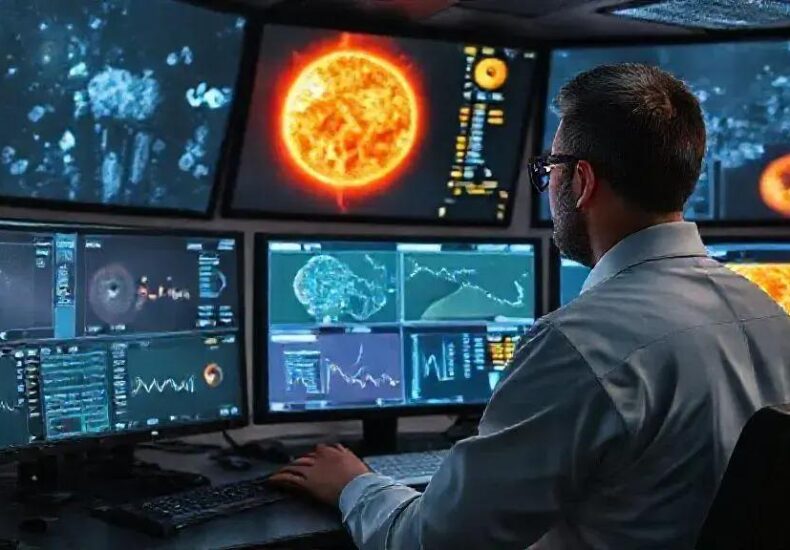
Real-Time Solar Weather Feeds: How to Stay Informed
Real-Time Feeds provide instant updates on solar weather events like solar flares and geomagnetic storms, enabling timely alerts and protection for satellites, communication systems, and power grids against solar activity disruptions.
Real-Time Feeds for solar weather have changed how people track space weather events. Ever wondered how you could spot solar storms or flares as they happen? This guide dives into why live updates matter and how they affect daily tech and communications.
what are real-time solar weather feeds?
Real-time solar weather feeds provide continuous updates on solar activity such as solar flares, coronal mass ejections, and geomagnetic storms. These feeds deliver live data from satellites and ground-based observatories, allowing users to monitor the sun’s behavior as it happens. This immediate information is crucial for scientists, satellite operators, and anyone affected by space weather events.
Sources of real-time feeds
Most real-time solar weather feeds come from agencies like NASA, NOAA, and international space weather monitoring centers. These organizations use specialized instruments to track solar phenomena and publish the data through websites, APIs, and mobile applications.
Types of data provided
The feeds typically include solar flare alerts, solar wind speed, magnetic field measurements, and warnings about geomagnetic storms. Users can access charts, graphs, and live images of the sun’s surface to stay informed.
Why real-time feeds matter
Since solar activity can impact GPS, radio communications, power grids, and even airline routes, having instant access to solar weather updates helps mitigate risks. For example, operators can take precautionary measures to protect electrical infrastructure or adjust satellite operations during solar storms.
By understanding what real-time solar weather feeds offer, individuals and organizations can better prepare for the effects of space weather and make timely decisions based on accurate, up-to-the-minute information.
how real-time data impacts solar weather monitoring
Real-time data dramatically improves the monitoring of solar weather by providing instant access to changing conditions on the sun. This timely information helps scientists and agencies detect solar flares, coronal mass ejections, and other events as they happen, allowing for faster analysis and response.
Enhancing prediction accuracy
With constant data streams, models used to forecast space weather become more accurate and reliable. This helps reduce false alarms and improves the timing of warnings sent to industries affected by solar activity.
Protecting infrastructure
Solar weather monitoring based on real-time data is essential for safeguarding satellites, power grids, and communication networks. Early detection allows operators to activate protective measures, reducing damage and downtime.
Supporting research and public safety
Continuous real-time updates enable better research into solar phenomena by providing detailed observations over time. Public safety also benefits as airlines, navigation systems, and emergency services receive relevant alerts to adjust operations accordingly.
Overall, real-time data transforms solar weather monitoring from a reactive process to a proactive one, making space weather information more useful and accessible.
main sources of solar weather real-time feeds
Several key organizations provide real-time solar weather feeds that help monitor solar activity around the clock. These sources gather data using satellites, ground stations, and specialized sensors to track events like solar flares and geomagnetic storms.
NASA and the Solar Dynamics Observatory (SDO)
NASA operates the Solar Dynamics Observatory, which captures high-resolution images of the sun and transmits live data on solar activity. The SDO is a primary source of continuous, accurate solar observations used worldwide.
NOAA’s Space Weather Prediction Center (SWPC)
The National Oceanic and Atmospheric Administration’s SWPC provides real-time alerts and forecasts on space weather. They use satellites such as the GOES series to monitor solar phenomena and distribute accessible data for public and industry use.
European Space Agency (ESA) and international networks
ESA contributes through missions like Solar Orbiter, supplying detailed solar data. Additionally, international collaborations pool data from various global observatories, boosting the availability and reliability of solar weather feeds.
Other specialized services
Private companies and academic institutions also offer solar weather feeds, often enhancing official data with custom alerts or user-friendly platforms. Examples include universities’ space weather labs and commercial satellite operators who monitor solar effects.
By relying on these trusted sources, individuals and organizations can access dependable real-time solar weather information to stay prepared for solar events.
tools and platforms to access live solar weather data
Accessing live solar weather data is easier than ever thanks to a variety of available tools and platforms. These resources offer real-time updates, alerts, and detailed visualizations to help users stay informed about solar activity.
Online dashboards and websites
Many organizations provide user-friendly websites with interactive dashboards showing solar weather conditions. Examples include NASA’s Solar Dynamics Observatory page and NOAA’s Space Weather Prediction Center, which offer live feeds of solar flares, sunspots, and geomagnetic storm warnings.
Mobile apps
Several mobile applications deliver push notifications and real-time updates about solar weather. Apps like Space Weather Live and Solar Monitor allow users to monitor solar activity from anywhere, receiving alerts about significant solar events as they occur.
APIs for developers
For more technical users, APIs from agencies like NOAA and private services enable developers to integrate live solar weather data into custom applications. This allows automation of alerts, data analysis, and visualization tailored to specific needs.
Specialized software and platforms
Professional-grade software used by researchers and industries offers in-depth solar monitoring tools. These programs combine live data streams with advanced analytics to predict impacts on satellites, power grids, and communication systems.
Using these tools and platforms, anyone from casual observers to professionals can access live solar weather data and stay ahead of solar events.
understanding solar flares and their alerts
Solar flares are sudden bursts of energy and light emitted from the sun’s surface. These powerful explosions release large amounts of radiation across the electromagnetic spectrum, including X-rays and ultraviolet rays. Solar flares vary in size and strength, and their impact on Earth depends on their intensity and duration.
How solar flares are detected
Satellite instruments continuously monitor the sun’s activity to detect solar flares instantly. Sensors measure bursts of X-rays and extreme ultraviolet radiation, triggering alerts when significant flares occur. These alerts help scientists track solar events and predict potential effects.
Types of solar flare alerts
Alerts categorize flares by their magnitude, ranging from A-class (smallest) to X-class (strongest). An X-class solar flare can disrupt communications, navigation systems, and electric grids. Alerts inform industries and the public to prepare and protect sensitive systems.
Why monitoring solar flares matters
Solar flare alerts provide critical information to satellite operators, power companies, and aviation industries. By understanding the timing and strength of flares, they can take actions to reduce damage, such as rerouting flights or powering down vulnerable equipment.
Keeping up with solar flare alerts ensures that both technology-dependent systems and daily life remain safeguarded from sudden solar disturbances.
how real-time feeds help protect communication systems
Real-time solar weather feeds play a vital role in protecting communication systems from solar storms and disruptions. These feeds provide immediate alerts about solar flares and geomagnetic disturbances that can interfere with satellite and radio communications.
Impact of solar activity on communication
Solar storms can cause signal degradation, data loss, and outages in satellite communications, GPS, and radio transmissions. High-frequency radio waves, used by aviation and maritime industries, are especially vulnerable to solar interference during active solar events.
How real-time feeds provide protection
By delivering instant updates on solar weather, real-time feeds enable communication operators to take preventive measures. This can include switching to backup systems, adjusting satellite antennas, or temporarily shutting down sensitive equipment to minimize damage.
Industry applications
Satellite operators receive live solar weather data to predict and respond to solar radiation impacts. Similarly, emergency services and airlines rely on alerts to plan and maintain reliable communication during solar storms.
Overall, real-time feeds help ensure that communication networks remain stable and functional, even when solar weather poses a threat.
tracking space weather storms using live feeds
Tracking space weather storms using live feeds allows scientists and operational teams to follow solar and geomagnetic events in real time. These storms include solar flares, coronal mass ejections (CMEs), and geomagnetic storms that can impact Earth’s magnetic field and technology.
Real-time monitoring tools
Live feeds collect data from satellites and ground sensors to provide continuous updates on space weather conditions. Instruments measure solar wind speed, magnetic fields, and radiation levels, helping to identify approaching storms.
Predicting storm trajectories
By analyzing live data, scientists track the direction and speed of solar storms to forecast their arrival time at Earth. This information is crucial for issuing timely warnings to affected industries and infrastructure.
Responding to space weather storms
Real-time alerts help power grids, satellite operators, and communication networks prepare for potential disruptions. Actions might include adjusting satellite orbits, protecting transformers, or rerouting flights to avoid increased radiation exposure.
Using live feeds to track space weather storms improves forecasting and helps reduce the risks these natural events pose to technology and human activities.
importance of solar weather forecasting accuracy
Accurate solar weather forecasting is critical for minimizing the impacts of solar events on Earth-based technologies and infrastructure. Precise predictions help governments, industries, and individuals prepare for solar storms that could disrupt power grids, satellites, and communication networks.
Improving decision-making
Accurate forecasts allow utility companies to safeguard electrical equipment by activating protective protocols before a solar storm hits. Satellite operators can adjust orbits or power modes to prevent damage, reducing costly repairs or outages.
Protecting communication and navigation
Solar weather affects GPS accuracy and radio signal quality. Reliable forecasts enable airlines, maritime operators, and emergency responders to plan routes and communication strategies during solar disturbances, enhancing safety and efficiency.
Enhancing public safety and research
When forecasts are precise, authorities can issue timely warnings to the public about possible radiation exposure during flights or outdoor activities. Accurate data also benefits solar and space science research by offering clearer insights into solar processes.
Overall, the importance of solar weather forecasting accuracy lies in its ability to reduce risks, protect vital infrastructure, and improve preparation for space weather events impacting daily life and technology.
tips for staying informed with real-time solar feeds
Staying informed with real-time solar feeds ensures you never miss important updates about solar activity. Here are some practical tips to make the most of these live data streams and stay ahead of space weather events.
Choose reliable sources
Use trusted platforms like NOAA’s Space Weather Prediction Center or NASA’s Solar Dynamics Observatory for accurate real-time solar weather information. Reliable sources reduce the chances of misinformation or delayed alerts.
Set up alerts and notifications
Many websites and mobile apps offer customizable alert options. Enable push notifications or email updates for solar flares, geomagnetic storms, and other significant events to receive instant information wherever you are.
Use multiple platforms
Access data through websites, mobile apps, and APIs. Using diverse platforms lets you cross-check information and ensures you get notifications even if one service experiences downtime.
Understand key indicators
Familiarize yourself with common terms like solar flare classes (C, M, X) and geomagnetic storm scales. Knowing what these mean helps you interpret alerts and assess potential impacts effectively.
Stay updated regularly
Make it a habit to check live feeds periodically, especially during heightened solar activity. Regular monitoring helps you react promptly to changing conditions.
Following these tips can help individuals and organizations harness the power of real-time solar feeds to stay informed and prepared for solar weather events.
future trends in solar weather monitoring technology
Future trends in solar weather monitoring technology promise faster, more accurate, and more comprehensive detection of solar events. Advances in sensors, data processing, and artificial intelligence are driving these innovations.
Improved satellite instruments
Next-generation satellites will feature enhanced sensors that capture higher resolution images and more detailed measurements of solar activity. This will enable earlier detection of solar flares and coronal mass ejections with better accuracy.
Artificial intelligence and machine learning
AI-powered algorithms will analyze vast amounts of solar data swiftly, identifying patterns and predicting solar storms with greater precision. These technologies reduce human workload and help produce timely forecasts and alerts.
Integration with ground-based networks
Combining satellite data with information from ground observatories will create a more complete picture of space weather. This hybrid approach improves monitoring capabilities and provides redundancy for reliability.
Real-time global collaboration platforms
Future platforms will enable real-time data sharing and coordinated responses among international space weather centers. This collaboration will support faster decision-making to protect critical infrastructure worldwide.
These emerging technologies will transform how we monitor and respond to solar weather, enhancing our ability to mitigate the effects of solar storms on technology and society.
Staying Ahead with Real-Time Solar Weather Feeds
Real-time solar weather feeds provide vital information that helps protect our technology and infrastructure from the sun’s unpredictable activity. By using trusted tools, setting up alerts, and understanding solar events, anyone can stay informed and prepared.
As monitoring technology advances, real-time data will become even more reliable and accessible, allowing quicker responses to solar storms. Staying up to date with these feeds is key to minimizing risks and ensuring smoother operation of communication and power systems.
Embracing real-time solar weather feeds empowers individuals and organizations to face space weather challenges with confidence and safety.
FAQ – Real-Time Solar Weather Feeds
What are real-time solar weather feeds?
Real-time solar weather feeds provide continuous, live updates about the sun’s activity, such as solar flares and geomagnetic storms.
Why is it important to monitor solar weather in real time?
Monitoring solar weather in real time helps protect satellites, power grids, and communication systems from damage caused by solar storms.
Which organizations provide reliable real-time solar weather data?
Trusted sources include NASA, NOAA’s Space Weather Prediction Center, and the European Space Agency, among others.
How can I receive alerts about solar weather events?
You can use websites, mobile apps, and email services that offer customizable alerts and notifications for solar activity.
How do solar flares affect communication systems?
Solar flares can disrupt radio signals, GPS accuracy, and satellite communication, potentially causing outages and delays.
What future technologies will improve solar weather monitoring?
Advances include enhanced satellites, AI-powered data analysis, integration of ground and space data, and global collaboration platforms for faster warnings.
You may also like



Leave a Reply