From Sunspots to Solar Flares: Key Terms Explained
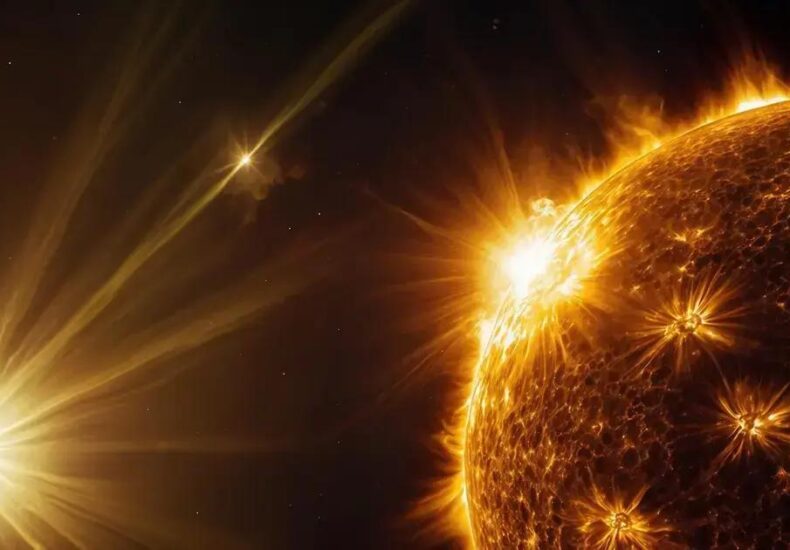
Sunspots are cooler, dark regions on the Sun caused by intense magnetic activity, and their study helps predict solar flares and storms that impact Earth’s space weather and technology.
Sunspots are not just dark spots on the sun’s surface; they’re windows into the star’s turbulent nature. Ever wondered how these features tie into powerful solar flares and affect space weather around us? Let’s break down the key terms to get a clearer picture.
what are sunspots and how they form
Sunspots appear as dark patches on the Sun’s surface due to intense magnetic activity that inhibits the normal flow of heat. These cooler regions, although darker compared to their surroundings, still emit a tremendous amount of light and energy. Sunspots form when magnetic field lines become twisted and concentrated, creating areas where convection is disrupted.
The formation process
Magnetic flux tubes rise from the Sun’s interior and break through the photosphere, the Sun’s visible surface. This causes a suppression of hotter plasma from carrying heat to the surface, resulting in cooler, darker areas called sunspots. These spots often appear in pairs or groups with opposite magnetic polarity.
Characteristics of sunspots
Sunspots vary in size, some large enough to be visible from Earth without telescopes. They usually have a dark center known as the umbra surrounded by a lighter area called the penumbra. Their numbers and size change in cycles averaging about 11 years, impacting solar radiation and space weather.
Understanding sunspots helps scientists monitor solar activity and predict effects on satellites, communications, and power grids here on Earth. Their formation is a key piece in studying our dynamic star.
the relationship between sunspots and solar activity
Sunspots serve as clear indicators of the Sun’s magnetic activity levels, which directly relate to the broader phenomenon of solar activity. Higher numbers of sunspots usually mean the Sun is more active, leading to greater occurrences of solar flares and coronal mass ejections (CMEs).
The solar cycle and sunspot numbers
The Sun goes through an approximately 11-year cycle, fluctuating from solar minimum—few or no sunspots—to solar maximum, when sunspots peak. During solar maximum, intense magnetic activity triggers solar flares, which release large bursts of energy, and CMEs, which can send charged particles streaming into space.
Impacts of increased solar activity
Increased solar activity affects space weather, potentially disrupting satellite communications, GPS signals, and power grids on Earth. Scientists monitor sunspot counts to forecast these impacts. Sunspot groups with complex magnetic fields tend to produce stronger, more frequent solar events.
Understanding this relationship helps researchers predict space weather and protect technology that depends on stable solar conditions. Observing sunspots provides a practical way to gauge when solar activity might escalate.
understanding solar flares and their impact
Solar flares are sudden and intense bursts of radiation caused by the release of magnetic energy stored in the Sun’s atmosphere. They occur near sunspots where magnetic fields are complex and twisted. When these fields suddenly realign, they unleash vast amounts of energy.
Types and intensity
Solar flares can range from small, short-lived events to massive explosions that release energy equivalent to billions of atomic bombs. Scientists classify flares by their X-ray brightness into classes A, B, C, M, and X, with X-class flares being the strongest.
Effects on Earth and space
Radiation from solar flares can disrupt radio communications, GPS signals, and power grids on Earth. They also increase the radiation exposure for astronauts and can cause beautiful auroras near the poles. Intense flares are often followed by coronal mass ejections (CMEs), which send plasma and magnetic fields hurtling through space.
Monitoring solar flares helps predict space weather, allowing satellites, power companies, and airlines to prepare for disruptions. Understanding these powerful events is crucial for managing their impact on modern technology and life on Earth.
magnetic fields and their role in solar phenomena
The Sun’s magnetic fields play a crucial role in shaping solar phenomena such as sunspots, solar flares, and coronal mass ejections (CMEs). These fields are generated by the movement of charged particles in the Sun’s interior and extend outward through the solar atmosphere.
Magnetic field lines and sunspots
Sunspots form where magnetic field lines emerge from the Sun’s surface and loop back, creating intense magnetic regions. These lines suppress convection, causing cooler areas that appear as dark sunspots. The complexity and strength of these fields affect how active a sunspot region is.
Connection to solar flares and CMEs
When magnetic field lines become twisted or tangled, they can suddenly rearrange or reconnect, releasing huge amounts of energy as solar flares. This process can also eject plasma and magnetic fields into space in the form of CMEs, which carry solar material outward.
Understanding magnetic fields helps scientists predict the timing and intensity of solar eruptions. The dynamic nature of these fields makes the Sun a highly active star, influencing space weather and Earth’s environment.
effects of sunspots and solar flares on earth
Sunspots and solar flares significantly impact Earth’s space environment through changes in solar radiation and charged particle emissions. These effects can disrupt communication, navigation, and power systems that rely on satellites and ground-based technology.
Disruption of communication systems
Solar flares release bursts of X-rays and ultraviolet radiation that can disturb the ionosphere, a layer of Earth’s atmosphere critical for radio signal transmission. This interference can cause radio blackouts, affecting aviation, maritime, and emergency communication.
Impact on satellite and GPS signals
Enhanced solar activity can cause fluctuations in the Earth’s magnetic field leading to signal degradation or loss for GPS and satellite services. This affects everyday technologies such as navigation apps and weather forecasting satellites.
Effects on power grids
Geomagnetic storms, triggered by solar flares and associated coronal mass ejections, induce electric currents in power lines. These currents can overload transformers and cause widespread power outages, posing risks to energy infrastructure and economy.
Auroras, the colorful lights seen near polar regions, are a visible and beautiful result of solar particle interactions with Earth’s magnetic field, showing a direct natural link between solar activity and our planet.
tracking and predicting space weather events
Tracking and predicting space weather events is essential to protect satellites, power grids, and communication systems from solar storms. Scientists use various tools and techniques to monitor the Sun’s activity and forecast potential impacts on Earth.
Satellites and solar observatories
Space-based observatories like the Solar and Heliospheric Observatory (SOHO) and the Solar Dynamics Observatory (SDO) continuously observe the Sun, capturing images of sunspots, solar flares, and coronal mass ejections. These satellites provide real-time data on solar activity.
Ground-based monitoring
Ground observatories track changes in Earth’s magnetic field and ionosphere, which help detect incoming solar storms. Instruments such as magnetometers and radio telescopes record variations that may indicate increased solar activity.
Space weather forecasting models
Scientists use complex computer models that simulate solar wind and magnetic field interactions with Earth’s magnetosphere. These models help predict the timing, strength, and potential effects of space weather events, allowing for early warnings.
Monitoring space weather enables governments, businesses, and researchers to prepare for solar storms, protect vital infrastructure, and reduce the risk of costly damage or service interruptions.
how sunspot studies help us prepare for solar storms
Studying sunspots is vital for understanding and preparing for solar storms, which can disrupt modern technology and communication. By analyzing sunspot behavior, scientists can gain insights into the Sun’s magnetic activity and predict periods of increased solar storms.
Sunspot monitoring techniques
Researchers use telescopes and satellites to monitor sunspot size, number, and magnetic complexity. These observations help identify when the Sun is entering a more active phase, signaling a greater chance of solar flares and coronal mass ejections.
Predicting solar storms
Sunspot activity often precedes solar storms, so tracking these spots allows scientists to forecast potential events. Complex sunspot groups with strong magnetic fields are especially likely to produce significant solar eruptions.
Preparing for space weather events
Early warnings informed by sunspot studies enable power companies, satellite operators, and communication networks to take protective measures. This can include adjusting satellite orientation, strengthening power grid defenses, and preparing backup communication systems.
Overall, continuous sunspot study enhances our ability to predict and mitigate the effects of solar storms, keeping technology and infrastructure safer on Earth.
Understanding our Sun’s influence
Sunspots and solar flares are key to understanding how the Sun affects space weather and life on Earth. By studying sunspots, scientists can better predict solar storms and help protect our technology and environment.
Tracking solar activity helps us prepare for disruptions in communication, power, and navigation systems. As we continue learning more about these solar phenomena, we gain valuable tools to stay safe and aware of the dynamic space around us.
FAQ – Common Questions About Sunspots and Solar Activity
What are sunspots?
Sunspots are dark, cooler areas on the Sun’s surface caused by intense magnetic activity that blocks heat.
How do sunspots relate to solar flares?
Sunspots are regions of strong magnetic fields; when these fields twist and reconnect, they can trigger solar flares.
What effects do solar flares have on Earth?
Solar flares can disrupt radio communications, GPS signals, and power grids, and cause beautiful auroras near the poles.
How often do sunspots appear?
Sunspots appear in cycles of about 11 years, peaking during the solar maximum phase.
Why is tracking sunspots important?
Tracking sunspots helps predict solar storms, allowing us to prepare and protect technology and infrastructure on Earth.
What tools do scientists use to study sunspots and solar activity?
Scientists use satellites, space-based observatories, and ground telescopes to monitor sunspots and solar events in real time.
You may also like

Leave a Reply