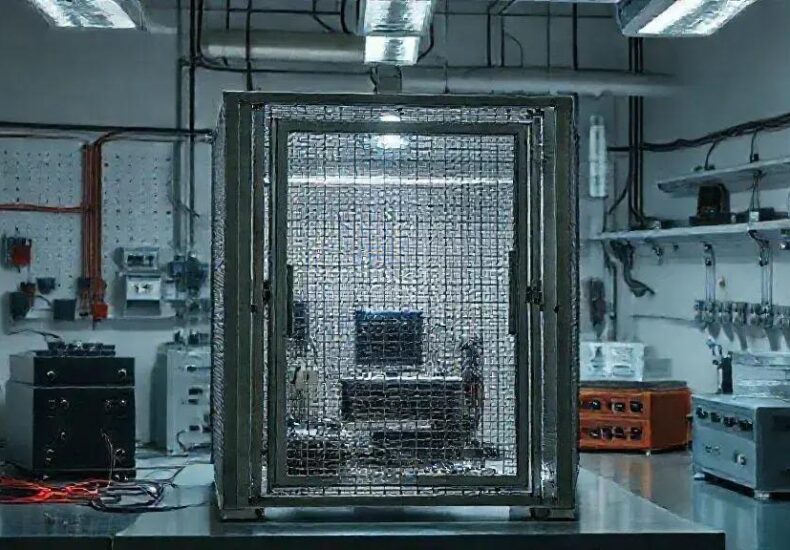
Understanding Faraday Cages: Their Function and Importance in Modern Science
A Faraday cage is a protective enclosure made of conductive materials that blocks electromagnetic fields, safeguarding sensitive electronics from interference. Commonly used in devices like microwaves and medical equipment, these cages are crucial for maintaining optimal performance and security in various settings.
Faraday cages play a vital role in protecting our technology from electromagnetic interference. Ever wondered how these fascinating structures work? Let’s dive in!
Introduction to Faraday Cages
A Faraday cage is a special enclosure made of conductive materials. Its main job is to block electromagnetic fields. Imagine a shield that keeps the bad stuff out while letting good things stay safe inside. Faraday cages are used everywhere, including in your home and in science labs.
When electricity flows, it creates a magnetic field. If something strong passes by, it can mess up your electronic devices. That’s where Faraday cages come in handy. They can protect sensitive gadgets from these unwanted signals.
Used for decades, Faraday cages have become essential in our tech-filled world. You might not see them, but they’re likely around you. They help keep our electronics running smoothly by creating a safe zone, free from interference.
Historical Background: Franklin and Faraday
The story of Faraday cages goes back many years. It starts with two brilliant minds: Benjamin Franklin and Michael Faraday. Franklin was one of the first people to study electricity.
In the 1700s, Franklin discovered that lightning is a form of electricity. He showed this by flying a kite during a storm. His work helped people understand the power of electricity.
Later, Michael Faraday took things to another level. He lived in the 1800s and made many discoveries in electromagnetism. Faraday figured out how electric fields work. He also created the concept of the Faraday cage.
Faraday’s cage is named after him. It’s based on his understanding of how electric fields behave. Faraday showed that a conductive material can block electric fields, which is important for protecting sensitive electronics.
Thanks to Franklin and Faraday, we now have tools to manage electricity safely. Their early experiments led to the technology we use today.
How Faraday Cages Work
So, how do Faraday cages actually work? It’s pretty fascinating! First, let’s break it down. When there’s an electric field around a conductive material, the electric charges move. This movement happens very quickly. They align themselves on the surface of the conductor.
This means the interior of the cage is shielded. No electric fields can enter. That’s why it works so well for protecting electronics. Inside the cage, devices stay safe from outside interference.
Even if you have signals from outside, they can’t get in. This is because the charges on the cage push against the incoming fields. The result? The electric interference stays outside.
Faraday cages come in different shapes and sizes. They can be made of various materials, like metal mesh or solid metal. Some look like rooms, while others can be small boxes.
Remember, these cages can block various kinds of interference. They are great for shelters, labs, and even for things like your microwave! In every case, Faraday cages help keep our technology safe and sound.
Applications in Everyday Life
Faraday cages are not just a cool science experiment; they have real-world uses too! You might see them in many places without even realizing it. Let’s explore some common applications.
First, they protect our electronics. Many devices, like microwaves and cell phones, have some type of shielding. This keeps them safe from harmful interference.
Faraday cages are also used in hospitals. They help protect sensitive medical equipment from stray electrical signals. This way, devices can work correctly without problems.
In labs, scientists use Faraday cages during experiments. They often need a controlled environment free from outside interference. The cages help ensure accurate results.
Moreover, some companies use them to protect data centers. These cages keep electronic data safe from electromagnetic pulses (EMPs) and other interference that could cause damage.
Finally, they’re important in the field of national security. Faraday cages can protect communication equipment during emergencies, ensuring that vital information stays safe.
As you can see, Faraday cages play a big role in our daily lives. They help us stay connected and safe in many different ways.
Examples of Faraday Cages in Use
There are many interesting examples of Faraday cages in use today. Each one plays a key role in protecting technology. Let’s take a look at some of them.
First, we have the classic microwave oven. Inside, there’s a metal mesh that acts like a Faraday cage. It keeps radiation inside, so you can heat your food safely without any mess.
Another example is in hospitals. MRI machines use Faraday cages to block outside electromagnetic interference. This ensures that the scans are clear and accurate. It keeps the patient equipment working properly without interference.
In labs, scientists often use Faraday cages around sensitive equipment. These cages protect devices from unexpected electrical signals. This is crucial when conducting experiments where accuracy is key.
Communication systems also use Faraday cages. For instance, military bases often shield their communication devices to prevent eavesdropping. This keeps sensitive information safe from unwanted attention.
Finally, some consumer products, like certain phone cases, act as Faraday cages too. They block signals from reaching your device, making them great for privacy. Users can feel secure knowing their information is protected.
These examples show how versatile Faraday cages can be. They’re essential in many areas of life, giving us safety and reliability in technology.
Future Developments and Innovations
The future looks bright for Faraday cages. With new technology, we can expect exciting developments and innovations. Scientists are always exploring how to make these cages even better.
One area of interest is materials. Researchers are working on new types of conductive materials. These new materials aim to be lighter and more efficient. This could lead to smaller and more powerful Faraday cages.
Another exciting development is in nanotechnology. Using tiny particles, scientists can create advanced coatings for everyday objects. This means common items, like phones or tablets, could use Faraday cage technology without being bulky.
In addition, the rise of smart technology opens new doors for Faraday cages. As smart devices become more common, their security is crucial. Innovative Faraday cages could provide protection against hacking and signal interference.
Moreover, more people are becoming concerned about privacy. Future Faraday cages might be designed to protect personal devices from surveillance. This could lead to new consumer products focused on individual security.
Overall, the potential for Faraday cages is huge. As technology advances, so will the ways we use these protective enclosures. They’ll keep evolving to meet our needs and enhance our safety.
You may also like




Leave a Reply